
Characteristics and Applications of Nine Common Plant-Fiber PP Composites
A practical comparison of cereal, wheat-straw, coconut-coir, coffee-ground, bamboo, tea, palm, corn-starch and wood-filled PP materials.
Buyer and engineer FAQ
Questions buyers ask when comparing plant-filled PP grades
Are cereal-fiber PP and wheat-straw PP necessarily made from different plants?
No. In this product range, the cereal-fiber grade also uses finely processed wheat-stem straw. The practical difference comes from raw-material selection, particle-size distribution, treatment, loading and the complete formulation—not merely the crop name.
Does a 4,400 MPa coconut-coir masterbatch keep the same modulus after dilution?
No. That value describes the concentrated masterbatch sample. The final compound changes with the masterbatch ratio, dilution PP, compatibility, moisture and molding history. Calculate theoretical fiber content, then test the actual molded blend.
Can every tea-fiber PP product be sold as antibacterial?
No. Tea-derived feedstock may contain polyphenolic compounds, but an antibacterial claim belongs to the exact finished formulation and test method. Request a report for the production grade and do not transfer a result from raw tea or another formulation.
Is corn-starch PP compostable or fully biodegradable?
No. It still contains a polypropylene matrix unless a different certified formulation is specified. Starch can introduce renewable content and change appearance or cost, but it does not make the finished PP article compostable. Composition and end-of-life claims must be verified separately.
For grade selection, share the target color, visible-fiber level, odor limit, wall thickness, gate design, mechanical targets, regulatory market and annual volume with wooyopet.
The Fiber Source Changes More Than the Sustainability Story
The most important difference among plant-filled polypropylene materials is not the word “plant.” It is the complete combination of feedstock, particle geometry, treatment, loading, carrier or matrix, compatibilizer and processing history. Two materials based on PP can produce noticeably different color, grain, odor, stiffness, impact response, shrinkage and molding behavior when one contains finely milled straw and the other contains coarse wood or coconut coir.
A buyer who asks only whether a compound contains bio-based material will not have enough information to predict the molded part. The better questions are: Which plant fraction is used? Is the product a ready compound or a concentrated masterbatch? What test method and condition produced each number? Does the food-contact or antibacterial report cover the exact grade? What surface sample has been approved under production conditions?
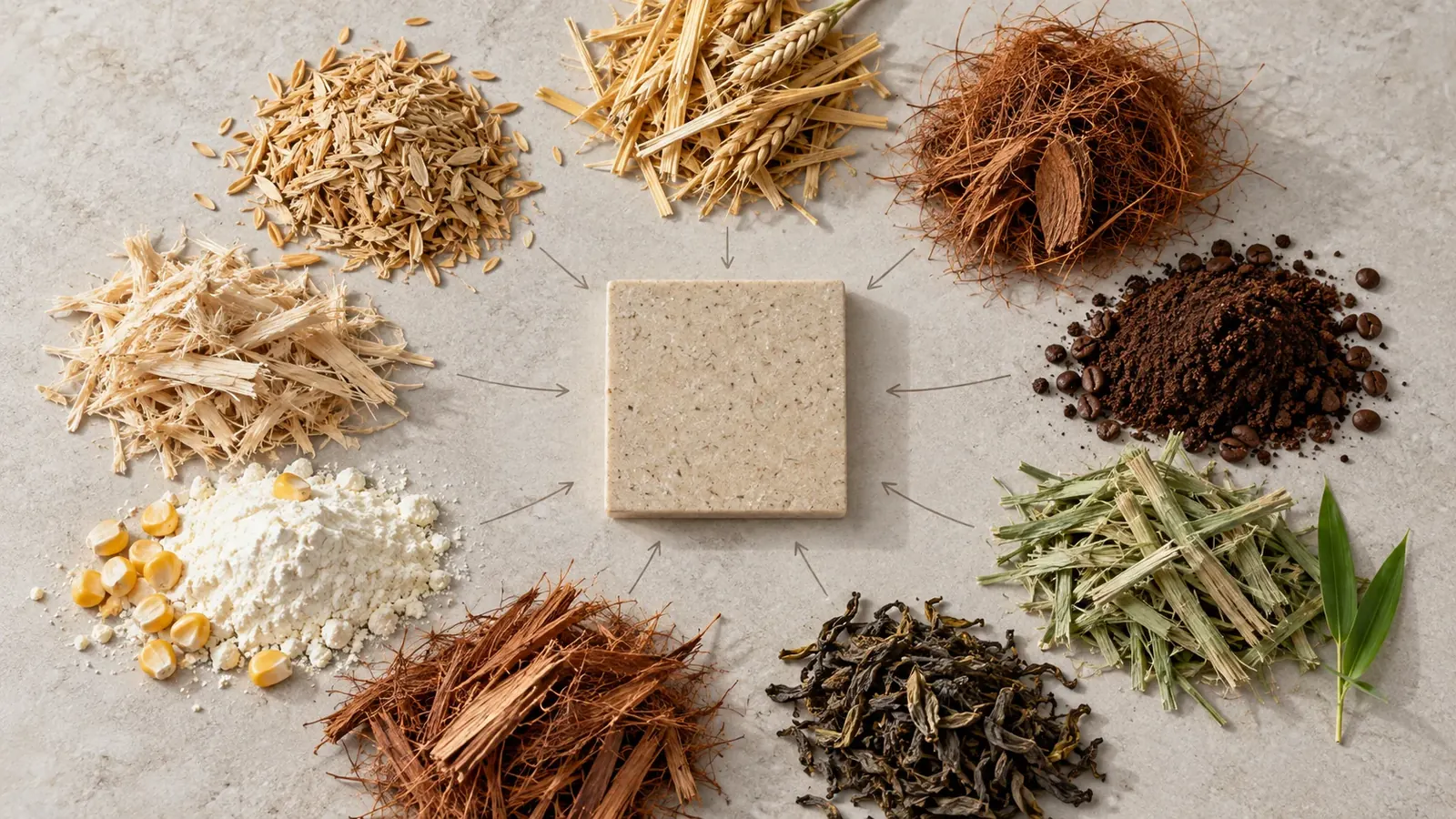
This guide compares nine common material routes in the wooyopet PP portfolio: fine cereal fiber, coarser wheat straw, coconut coir, spent coffee grounds, bamboo, tea, palm, corn starch and pine wood. Eight use recognizable fibrous or particulate plant feedstocks. Corn starch is included because it belongs to the same plant-filled PP selection set, although starch is a plant-derived filler rather than a fiber in the strict morphological sense.
| Comparison Rule | Why It Matters | Buyer Check |
|---|---|---|
| Ready compound versus masterbatch | A concentrated masterbatch value does not describe a diluted production blend | Request the approved final ratio and test the final compound |
| Same test condition | MFR, impact and HDT values are not comparable when load, temperature or method differs | Read the method and condition beside every number |
| Feedstock treatment | Particle size and refinement can matter as much as the plant name | Approve a molded plaque and define visible-fiber limits |
| Formula-specific claims | Food-contact and antibacterial results cannot be transferred between grades | Match the report to grade, color, loading and intended use |
| Actual molded geometry | Flow, shrinkage and weld-line response depend on the part and mold | Run a production-representative molding trial |
1. Fine Cereal-Fiber PP
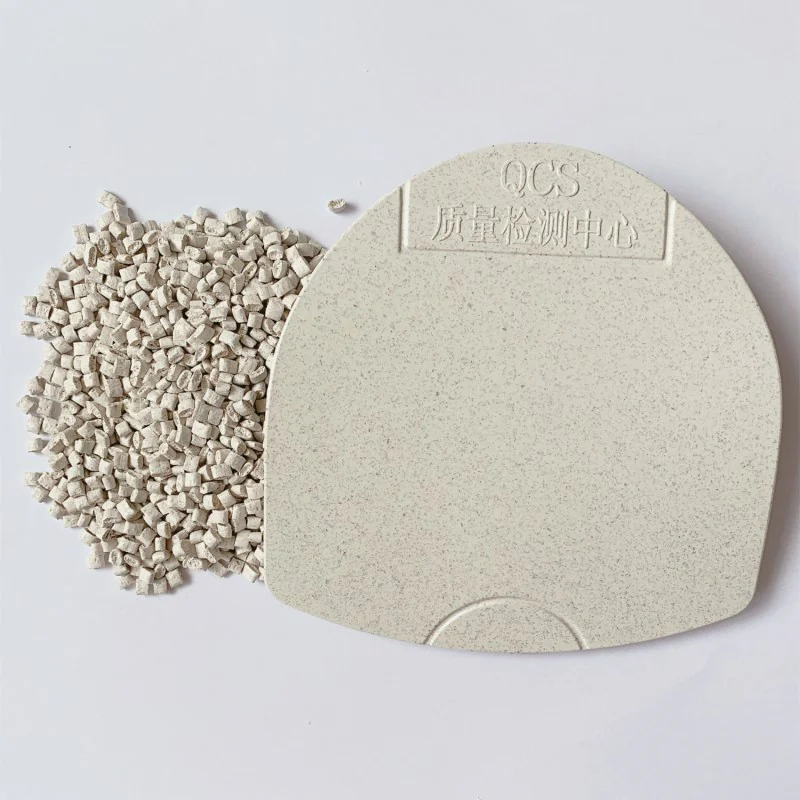
wooyopet grade WYC-PP P179002N is a ready-to-process PP compound using finely processed cereal-stem material. The current product description identifies wheat-stem straw as the plant source. Its “cereal fiber” name therefore describes the commercial grade family and its fine appearance; it should not be read as proof that it comes from a different crop than every wheat-straw grade.
The molded surface is pale gray-beige to light natural yellow, with dense, small plant marks rather than long coarse streaks. This makes it one of the easier plant-filled PP routes for light-colored organizers, containers, planters, hangers and selected food-contact projects. A mild straw or cereal note may be present, but odor intensity depends on the fiber lot, thermal history and storage.
Published mechanical values include 1.20 g/cm³ density, 31 MPa tensile strength, 55 MPa flexural strength, 1,956 MPa flexural modulus, 3.8 kJ/m² notched impact strength and 73 HD Shore hardness. Project documentation also lists an MFR of 9.5 g/10 min at 230°C / 2.16 kg. This gives the grade a useful balance of stiffness and moderate flow; thin walls and long flow paths still require gate, pressure and venting validation.
The grade is supported by FDA-related documentation on the current product page. That does not mean every color or modified blend is automatically approved for every food-contact condition. Match the report to the exact production formulation, intended food, temperature and contact time.
Best fit: pale molded products needing fine grain, practical stiffness and an available food-contact documentation route. Main limitation: moderate rather than high flow, plus the normal lot and color variation of a natural feedstock.
2. Coarser Wheat-Straw PP
WYC-PP P179050 is also a PP compound based on agricultural straw, but its finished appearance and mechanical balance differ from P179002N. The visible marks are coarser and less uniform. Depending on raw-material lot, color package and heat history, the natural shade can move from beige toward gray or gray-blue. This can be desirable in a rustic planter or dark organizer and less suitable for a tightly controlled white cosmetic part.
The reference data are 1.35 g/cm³ density, 18 MPa tensile strength, 34 MPa flexural strength, 2,000 MPa flexural modulus, 3.1 kJ/m² notched impact and 73 HD hardness. Project data list an MFR of 15 g/10 min at 230°C / 2.16 kg. Compared under the same reported MFR condition, it offers more flow than P179002N but substantially lower tensile strength. This makes it attractive for parts where filling and cost matter more than high structural load.
Useful applications include planters, trays, dark storage items, pet-bowl bodies and noncritical thin-wall products. It can also create a deliberately visible straw appearance in disposable items, provided the exact grade has the required food-contact documentation.
The advantage is a strong agricultural texture and relatively high reported flow. The limitations are coarser appearance, lower tensile performance and more obvious natural color variation. All plant-filled grades require mold care: use suitable corrosion-resistant or hardened steel, control moisture and clean deposits promptly rather than assuming that plant content alone determines corrosion.
3. Coconut-Coir Fiber PP Masterbatch
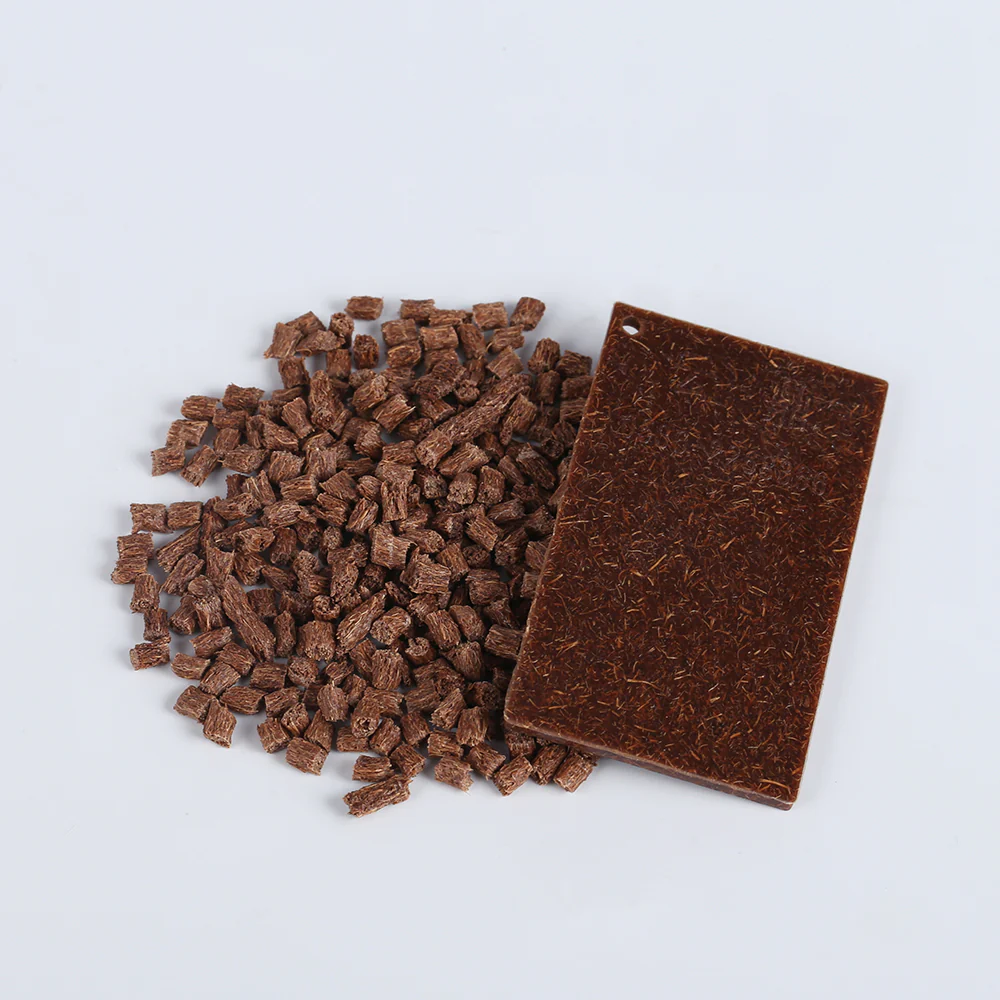
WYC-PP P179-YSML is a concentrated PP masterbatch rather than a ready compound. Its deep-brown pellets contain long, clearly visible coconut-coir elements that create one of the strongest natural-fiber signatures in the range. After dilution, individual marks may become more widely spaced and the overall color becomes lighter, but a pale or bright shade cannot reliably cover the dark natural base.
The masterbatch data include 1.17 g/cm³ density, 40 MPa tensile strength, 4.8% elongation, 1,300 MPa elastic modulus, 82 MPa flexural strength, 4,400 MPa flexural modulus and 3.9 kJ/m² notched impact. These values belong to the concentrated sample. They must not be inserted directly into the data sheet of a 25%, 50% or other diluted production blend.
wooyopet’s current use guidance calls for let-down with pure PP, using at least one part pure PP to one part masterbatch as the standard starting boundary. A one-to-three masterbatch-to-PP calculation would give about 15% theoretical fiber if the masterbatch contains 60% fiber, but modulus and impact will not decline in a guaranteed straight line. The dilution PP, compatibilization, dispersion and molding history must be fixed before the final blend is tested.
Best fit: planters, organizers, brush handles, decorative household parts and pet accessories where bold coir streaks are an intentional design feature. Main limitations: an extra blending-control step, restricted pale-color capability and a coarser touch than finely milled cereal or tea particles.
4. Spent-Coffee-Ground PP
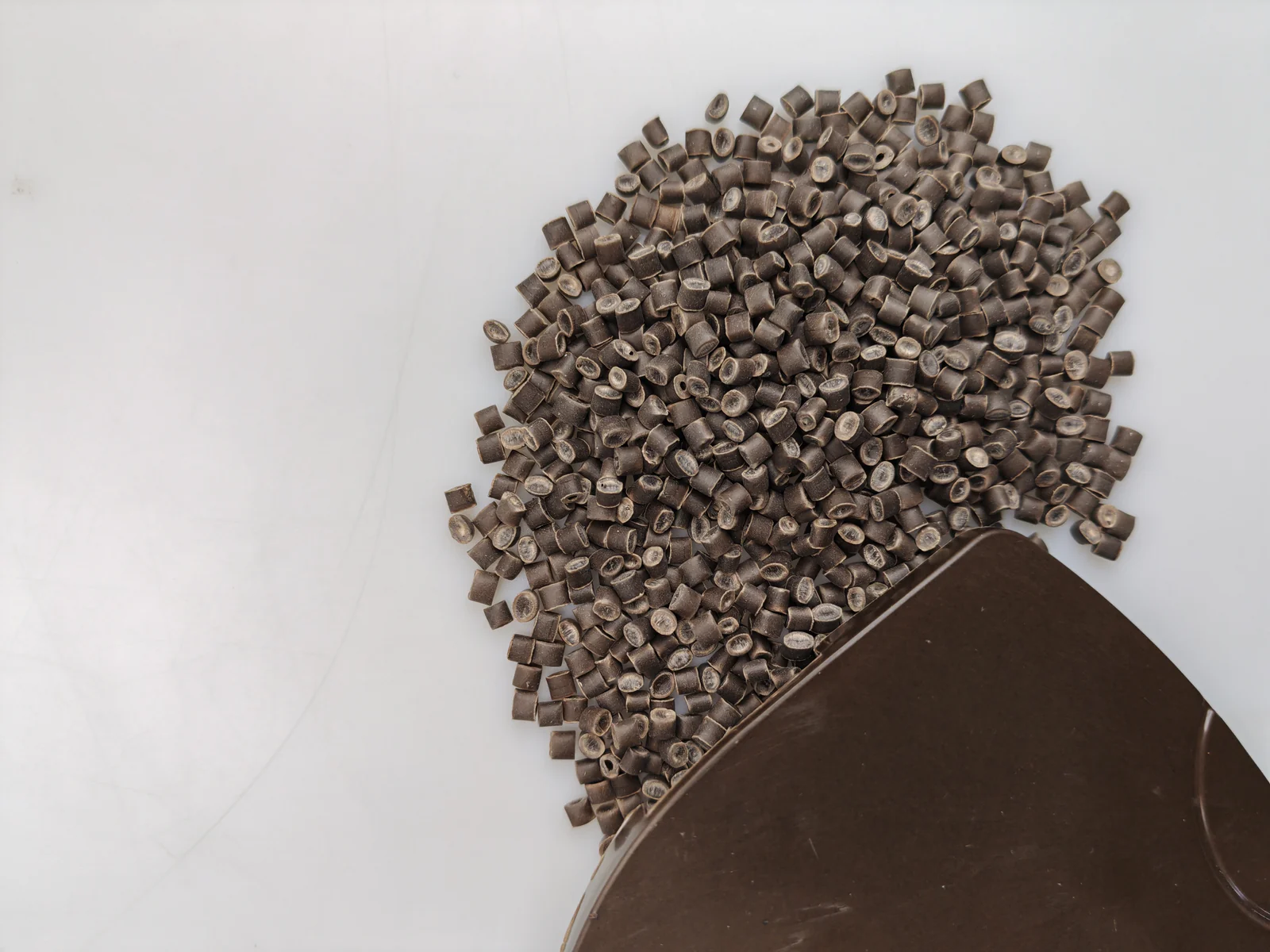
WYC-PP P179506N is a ready coffee-ground-fiber PP compound. Its natural color ranges from coffee brown to dark brown, with fine dark particles that resemble a chocolate or roasted-coffee surface. A light coffee note may remain after controlled processing, but aroma is not a guaranteed performance property: it changes with coffee feedstock, drying, residence time, packaging and age.
The data set lists 1.14 g/cm³ density, 23 MPa tensile strength, 4.6% elongation, 40 MPa flexural strength, 1,250 MPa flexural modulus, 3.6 kJ/m² notched impact and 71.5 HD hardness. Project documentation lists an MFR of 13.5 g/10 min at 230°C / 2.16 kg. The combination suits medium-wall injection parts and long but manageable flow paths, while the lower flexural modulus means the product designer should not expect the same wall rigidity as bamboo- or wood-fiber PP.
Typical applications include coffee-brand accessories, brown cutlery and stirrers, cup components, pet accessories, lifestyle goods and golf tees. Food-contact use depends on the exact report for the grade and finished formulation; the fact that the feedstock came from coffee does not establish food-contact compliance.
Best fit: products that benefit from a recognizable brown color and coffee-origin story. Main limitations: narrow light-color freedom, moderate stiffness and sensitivity to excessive temperature or residence time, which can darken the material and create burnt odor or black specks.
5. Bamboo-Fiber PP
WYC-PP P179203 uses bamboo fiber in a PP matrix. It produces a light beige or pale natural surface with fine, elongated plant marks. Particle classification changes the result: a finer screened fiber generally produces a more uniform appearance than a coarse fraction, so the buyer should approve the actual fiber specification and molded plaque rather than relying only on a nominal mesh description.
Published values include 1.19 g/cm³ density, 35 MPa tensile strength, 4.8% elongation, 62 MPa flexural strength, 2,420 MPa flexural modulus, 4.0 kJ/m² notched impact and 74 HD hardness. Project data list an MFR of 13.6 g/10 min at 230°C / 2.16 kg and machine-direction shrinkage around 0.8%–1.1%.
The material’s useful stiffness and pale surface make it suitable for organizers, small housings, personal accessories and Bluetooth-earbud storage boxes. Precision snap fits still require shrinkage measurement on the real mold. For a charging-case shell with a demanding hinge, mating gap and port opening, bamboo-fiber ABS may offer a more natural dimensional route.
Best fit: pale housings and daily-use products requiring higher stiffness and controlled fine grain. Main limitations: mold compensation for assembly parts, appearance sensitivity to particle classification and the need to validate any food-contact or odor statement on the exact grade.
6. Tea-Fiber PP
WYC-PP P179-402N combines PP with processed tea-derived particles. The natural color can range from green-gray to light tea brown, and the molded surface carries fine distributed marks. A light tea note may be perceptible in a fresh molding, but its intensity and persistence depend on feedstock and heat history.
The published mechanical set is 1.14 g/cm³ density, 26 MPa tensile strength, 4.3% elongation, 46 MPa flexural strength, 1,450 MPa flexural modulus, 3.5 kJ/m² notched impact and 72 HD hardness. Project documentation also reports a lower MFR than several other PP compounds. That points toward medium-wall products and a carefully controlled gate and pressure profile rather than an assumption of effortless thin-wall fill.
Tea packaging, trays, household accessories and pet-product components can benefit from the color and origin story. The raw tea feedstock may contain polyphenolic compounds, but that fact alone does not prove that the final molded PP article is antibacterial. An antibacterial or deodorizing claim requires a report for the exact formulation, test organism, method and result. Food-contact use likewise requires the corresponding grade report.
Best fit: products using a tea-origin surface as part of their identity. Main limitations: green-gray base color, moderate stiffness, lower flow in the referenced formulation and the need for test evidence before making functional claims.
7. Palm-Fiber PP
Palm-fiber PP represents a coarse, dark plant-fiber route. Depending on the palm feedstock and treatment, the fibers may appear dark brown or reddish brown and can create a stronger, rougher surface than a fine cereal or tea particle. Shear and residence time can shorten and darken the fibers during compounding and molding.
The current wooyopet palm-fiber PP masterbatch page does not publish the complete mechanical property set used for the ready compounds above. For that reason, the material should not be labeled simply as “high modulus” in a procurement specification without a current data sheet and a tested final let-down formulation.
Potential applications include dark organizers, outdoor accessories, panels and selected automotive-interior concepts where coarse texture is acceptable. Research interest in palm/PP systems does not automatically mean that one injection grade is production-approved for an automotive program. Odor, fogging, VOC, UV aging, impact, flame behavior and lot consistency must be tested against the target specification.
Best fit: development projects seeking a coarse dark agricultural-fiber appearance and willing to validate the final compound. Main limitations: a less standardized property package, stronger natural variation, odor and thermal-history sensitivity, and limited suitability for pale cosmetic parts.
8. Corn-Starch PP
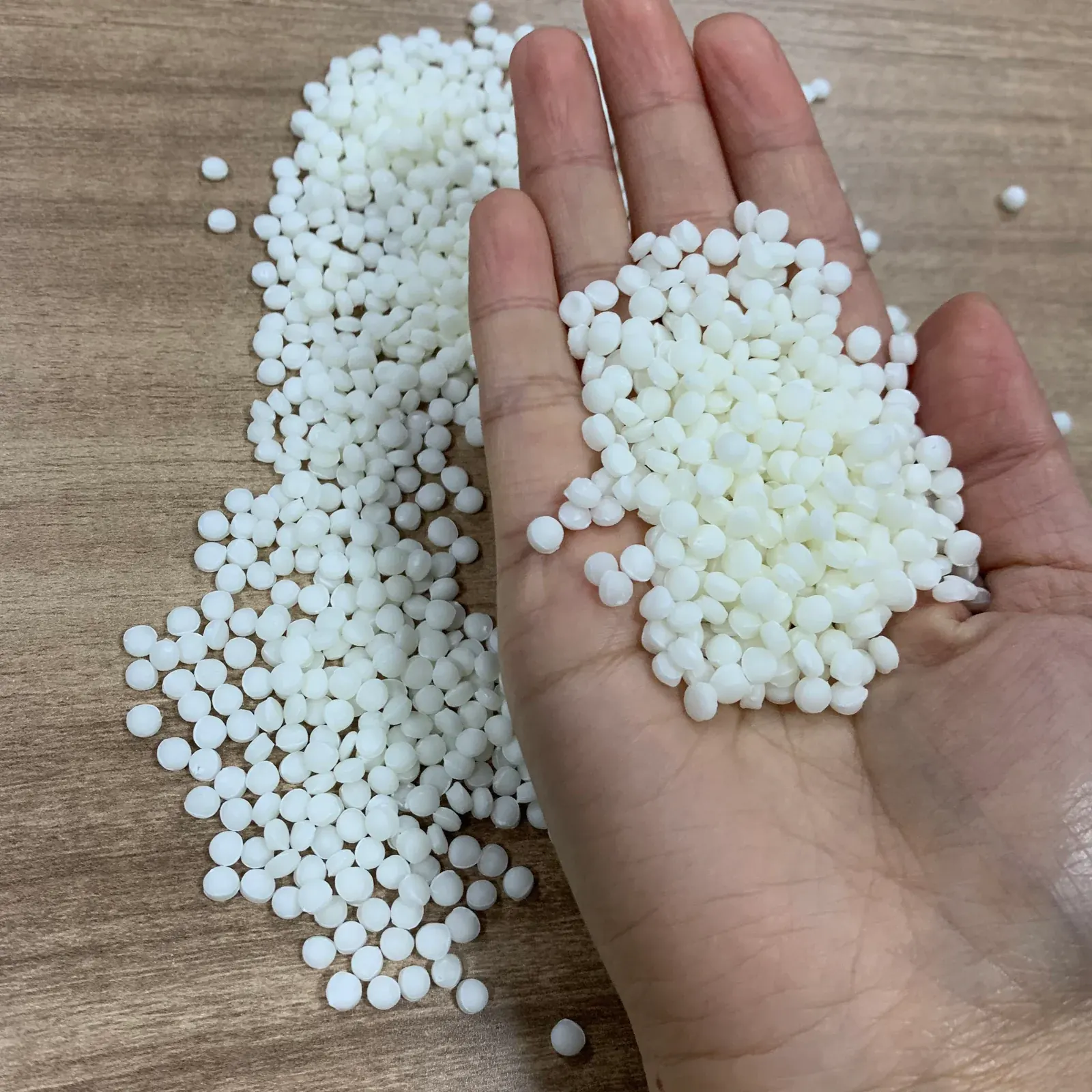
WYC-PP P179103 belongs in this selection guide because it is a plant-derived PP composite, but corn starch is not a fiber. The particles do not create long visible strands, so the molded surface can appear closer to conventional PP, with a light natural or pale-yellow tone and a relatively smooth or matte finish.
The current product data list 1.10 g/cm³ density, 10 MPa tensile strength, 25%–65% elongation at break and 1.4 kJ/m² notched Charpy impact. The grade can be processed by injection molding and extrusion, with a reference drying condition of 90–100°C for six hours. These values describe this grade; they do not support a general statement that every starch/PP material contains 50% thermoplastic starch.
Starch is polar while PP is nonpolar, so interface design and compatibilization strongly influence mechanical behavior. The renewable fraction and exact form of the starch must be confirmed from the formulation. Because the matrix contains PP, the material is not automatically compostable or fully biodegradable.
Possible uses include trays, containers, household articles and selected disposable products when the finished article meets the required strength and regulatory target. Food-contact status is not inherited from corn as a food crop; obtain the report for the exact polymer formulation and use condition.
Best fit: light-colored products that want plant-derived content without prominent fiber streaks. Main limitations: lower tensile and impact values in the published grade, compatibility dependence, weak natural-fiber visual identity and no automatic compostability claim.
9. Pine-Wood-Fiber PP
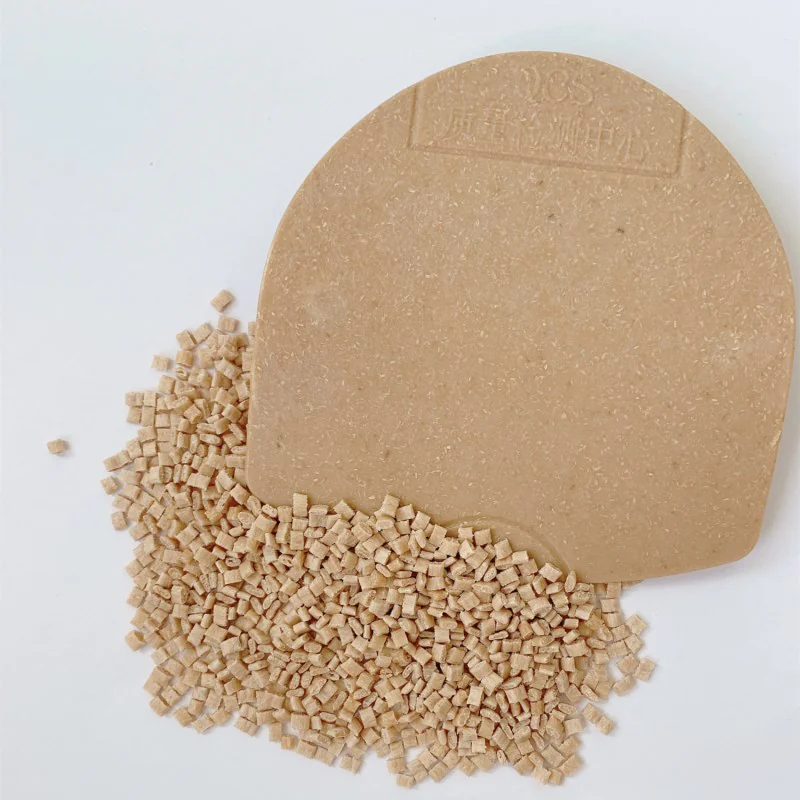
WYC-PP P179302 combines PP with pine wood fiber. The natural color is warm beige and the molded surface carries visible woody particles with a dry, lightly textured touch. A mild pine note may remain when the material is dried and processed within its window; excessive heat or residence time replaces that note with darkening and scorched odor.
The data set includes 1.11 g/cm³ density, 32 MPa tensile strength, 5.0% elongation, 47 MPa flexural strength, 2,210 MPa flexural modulus, 4.5 kJ/m² notched impact and 73 HD hardness. Project documentation lists an MFR of 7 g/10 min. The combination provides high stiffness and the highest notched-impact figure among the ready PP compounds compared here, although that statement applies only to this data set and test methods.
Pet chew sticks, rigid pet toys, bowls, planters, trays and household structural pieces can use the woody texture and mechanical balance. The surface can add grip, but no plastic chew product should be described as universally bite-proof or safe for every dog size and behavior. Finished-toy testing and use instructions remain necessary.
Best fit: rigid, medium-wall products that benefit from a strong wood identity and good impact balance. Main limitations: lower flow than the higher-MFR cereal and coffee grades, drying sensitivity and a narrow heat-history margin. Hardened or corrosion-resistant tooling and prompt cleaning are prudent across plant-filled systems; avoid attributing mold damage to a vague “bio-based corrosivity” mechanism.
Quick Comparison of the Nine Material Routes
The table below separates ready-compound values from masterbatch or development routes. A dash means that a directly comparable published value is not used here; it is not a claim that the property is zero.
| Plant Route | Typical Surface / Color | Form | MFR Reference | Flexural Modulus | Notched Impact | Best Starting Applications |
|---|---|---|---|---|---|---|
| Fine cereal / wheat-stem fiber | Pale, dense fine marks | Ready PP compound | 9.5 g/10 min | 1,956 MPa | 3.8 kJ/m² | Containers, organizers, planters, selected food-contact projects |
| Coarser wheat straw | Beige to gray-blue, coarse marks | Ready PP compound | 15 g/10 min | 2,000 MPa | 3.1 kJ/m² | Trays, planters, dark storage parts |
| Coconut coir | Dark brown, long visible streaks | Concentrated PP masterbatch | Confirm current condition | 4,400 MPa, masterbatch only | 3.9 kJ/m², masterbatch only | Bold-texture organizers, planters, handles |
| Coffee grounds | Coffee brown, fine dark particles | Ready PP compound | 13.5 g/10 min | 1,250 MPa | 3.6 kJ/m² | Brand accessories, brown utensils, golf tees |
| Bamboo fiber | Pale beige, fine elongated marks | Ready PP compound | 13.6 g/10 min | 2,420 MPa | 4.0 kJ/m² | Small housings, organizers, accessories |
| Tea particles | Green-gray to tea brown, fine marks | Ready PP compound | Grade-specific lower-flow reference | 1,450 MPa | 3.5 kJ/m² | Tea packaging components, trays, household goods |
| Palm fiber | Dark brown / red-brown, coarse | Masterbatch / development route | — | — | — | Dark panels, outdoor and interior development |
| Corn starch | Pale, smooth, no long fiber marks | Ready plant-filled PP grade | — | — | 1.4 kJ/m² Charpy, not Izod | Trays, containers, selected disposable goods |
| Pine wood fiber | Warm beige, woody particles | Ready PP compound | 7 g/10 min | 2,210 MPa | 4.5 kJ/m² | Pet toys, rigid household parts, planters |
A Three-Question Selection Method
First, define the color and visible-fiber target. Fine cereal and bamboo grades give the broadest pale-color starting point. Tea introduces a green-gray or tea-brown base. Coffee, coconut and palm are natural choices for darker parts. Corn-starch PP is useful when the design wants plant-derived content without obvious long fiber marks.
Second, define the surface character. Fine cereal and tea particles create a controlled dotted grain. Coarser wheat straw and coconut coir make the plant source more visible. Coffee produces a compact speckled brown surface. Pine wood gives a warm, dry woody texture. Approve this on the real part, because gate position, shear and wall thickness change fiber orientation.
Third, decide whether odor is a feature or a liability. Coffee, tea, straw and pine feedstocks may contribute a mild characteristic note, but odor is variable and should never be treated as a guaranteed substitute for fragrance. If a strict low-odor requirement applies, specify a finished-part odor limit and test conditioned production samples.
After those three questions narrow the visual route, use mechanical targets, flow, shrinkage, regulatory documents and production trials to make the final choice. The plant name starts the conversation; the complete formulation and molded-part evidence determine whether the material can actually be used.