
Key Injection-Molding Practices for Plant-Fiber Composites: From Drying to Mold Corrosion Protection
Plant-fiber PP and ABS are not processed by copying a conventional resin recipe. Moisture, thermal history, fiber concentration, flow, tooling and shutdown practice must be controlled as one production system.
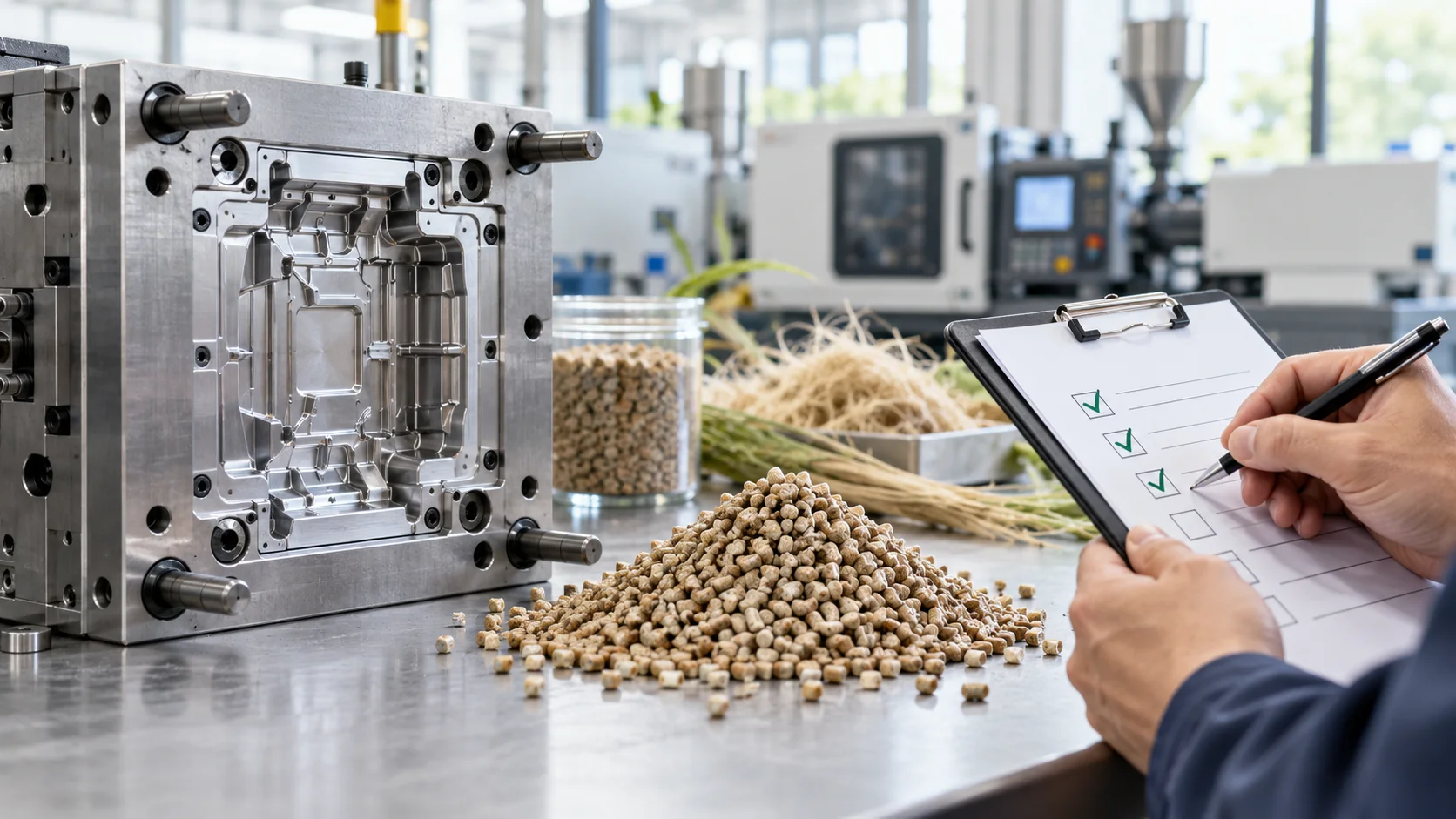
Buyer and engineer FAQ
Questions that should be answered before the first molding trial
Can every plant-fiber PP be dried at 100–105°C for two to three hours?
No. Drying depends on the exact grade, whether it is a ready compound or concentrated masterbatch, packaging history and ambient humidity. Current wooyopet PP examples range from 100–120°C for four to five hours to 120°C for two to three hours. Use the current grade sheet and verify moisture rather than applying one universal setting.
Is 220°C a universal carbonization limit for every plant fiber?
No. Thermal damage depends on fiber species, residual moisture, oxygen, additives and residence time. A compound can develop odor or black specks below a nominal decomposition temperature if it remains hot too long. Use the lowest melt temperature that gives stable plasticization and filling.
Must every mold be made from 304 or 316 stainless steel?
No. Those are general corrosion-resistant alloys, not universal cavity-and-core choices. Select a hardened corrosion-resistant mold steel or a suitable protective coating with the toolmaker according to surface finish, pressure, wear, expected volume and formulation. Existing ordinary steel tooling may be usable with disciplined cleaning and protection.
Does purging the barrel also clean and protect the mold?
No. Purging removes residual compound from the screw, barrel, nozzle and hot runner. Mold protection is separate: remove deposits from the cavity and vents, dry the surfaces, inspect cooling and condensation points, and apply the approved rust preventive before storage.
Can every high-fiber masterbatch be molded after a fixed 1:1 dilution?
No. Several wooyopet PP and PE masterbatches use one part compatible virgin resin to one part masterbatch as the minimum let-down starting point, but the final ratio must follow the specific grade and the target appearance, flow and mechanics. Never transfer a PP ratio to PE or ABS.
Many factories receive a plant-fiber PP or ABS compound and begin by copying the process used for the unfilled base resin. The first molded parts may then show silver streaks, flow marks, burnt particles, odor, flash, brittle corners or unstable dimensions. Tooling may also develop deposits or rust after repeated humid shutdowns.
The solution is not a single lower barrel temperature. A plant-fiber composite has a polymer matrix, a moisture-sensitive natural fraction, an interface system and, in some products, a concentrated masterbatch format. Drying, thermal history, shear, mold temperature, venting, packing, let-down ratio and shutdown practice interact. This guide organizes those variables into a production sequence for cereal, bamboo, wood, tea and coffee-ground PP compounds, as well as plant-fiber-filled ABS.
1. Start by Identifying the Material Form
Before setting the dryer, determine whether the material is a ready-to-mold compound or a concentrated masterbatch. A ready compound already contains the intended fiber loading and can normally be processed after the specified conditioning. A masterbatch carries a higher plant fraction and must be let down with a compatible base resin. Confusing the two changes melt flow, moisture load, stiffness, impact performance, shrinkage and color before the molding trial even begins.
Request the current technical data sheet for the exact grade and batch. Record the base resin, MFR test condition, density, recommended drying, barrel zones, mold temperature, masterbatch ratio and any regulatory restrictions. A result obtained on a masterbatch plaque cannot be assumed for the diluted final blend.
2. Drying: Use the Grade Window and Verify Moisture
Natural fibers contain hydroxyl-rich constituents that attract moisture. If wet material enters the barrel, water can flash into vapor and produce splay, silver streaks, bubbles, flow marks and unstable surface gloss. In moisture-sensitive matrices such as ABS, residual moisture can also amplify appearance defects. The correct response is controlled conditioning, not simply extending dryer time without checking the resin and fiber system.
Current wooyopet processing references show why one universal rule is unsafe. Cereal-fiber PP P179002N, wheat-straw PP P179050, bamboo-fiber PP P179203 and coffee-ground PP P179506N specify 100–120°C for four to five hours. Wood-fiber PP P179302 specifies 100–110°C for four to five hours. Concentrated tea-fiber PP masterbatch P179-CZML uses 120°C for two to three hours. Bamboo-fiber ABS A7015 WT234S uses 90–100°C for four to five hours, while coffee-ground ABS PA757 520 uses 90–100°C for five to six hours.
| Example Grade | Material Form | Published Drying Start Point | Key Control |
|---|---|---|---|
| P179002N / P179050 / P179203 / P179506N | Plant-fiber PP compounds | 100–120°C, 4–5 h | Keep dried material sealed and limit hopper reabsorption |
| P179302 | Wood-fiber PP compound | 100–110°C, 4–5 h | Control moisture without adding unnecessary heat history |
| P179-CZML | Tea-fiber PP masterbatch | 120°C, 2–3 h | Dry the masterbatch and compatible PP according to their own requirements |
| A7015 WT234S | Bamboo-fiber ABS compound | 90–100°C, 4–5 h | Use dry-air control for stable cosmetic surfaces |
| PA757 520 | Coffee-ground ABS compound | 90–100°C, 5–6 h | Prevent moisture pickup during transfer and stoppages |
A dehumidifying dryer is the most repeatable choice in humid climates and for cosmetic parts. Record inlet-air dew point, material temperature, residence time and throughput. A hot-air hopper can work for some stable, low-humidity conditions, but setpoint alone does not prove that the material reached the required moisture level. Use a moisture test when the surface requirement or scrap cost is high.
3. Melt Temperature: Control Both Setpoint and Residence Time
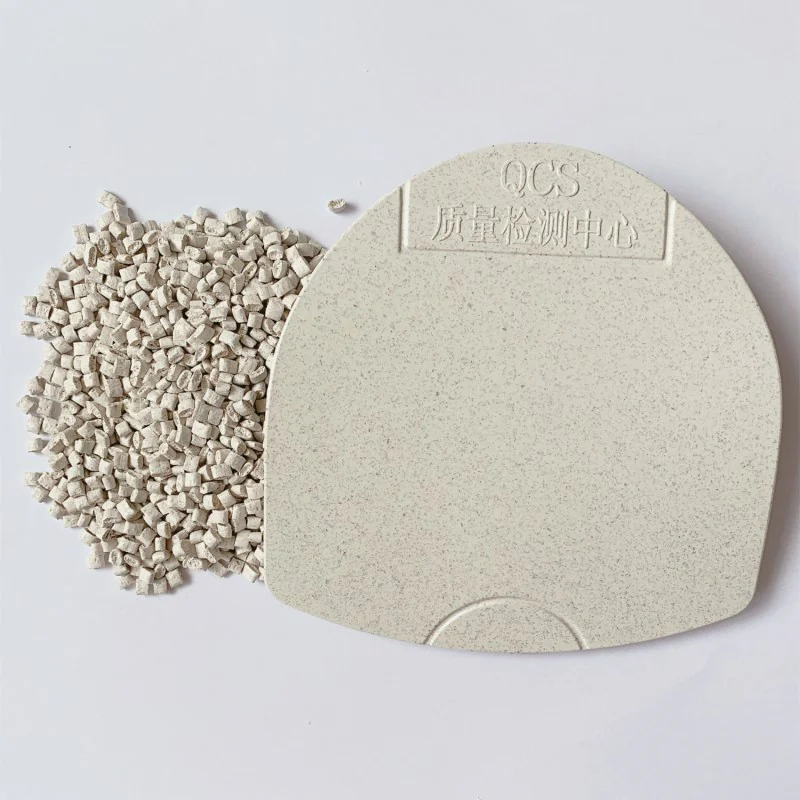
Natural plant fractions can discolor, release odor or form carbonized deposits when exposed to excessive heat. There is no single 220°C carbonization point that covers cereal, bamboo, wood, tea and coffee residues. Fiber composition, residual moisture, oxygen, additives, screw shear and time at temperature all change the response. A compound can produce black specks below a headline decomposition temperature if it remains in a hot barrel or hot runner for too long.
The practical rule is to begin at the lower end of the grade sheet and raise only the zones needed to achieve homogeneous plasticization and complete filling. Do not use nozzle temperature to compensate for a cold mold, inadequate venting, a small gate or an unsuitable high-viscosity dilution resin.
| Example Route | Rear Zone | Middle Zone | Front / Nozzle | Mold |
|---|---|---|---|---|
| Cereal, wheat-straw, bamboo or coffee-ground PP | 155–165°C | 160–175°C | 160–175°C | 60–80°C by grade |
| Wood-fiber PP P179302 | 165–175°C | 165–175°C | 175–185°C | 70–80°C |
| Bamboo-fiber ABS A7015 WT234S | 165–175°C | 175–180°C | 180–200°C | 60–90°C |
| Coffee-ground ABS PA757 520 | 165–175°C | 175–180°C | 180–195°C | 60–90°C |
These are start points, not guarantees for every machine. Actual melt temperature can differ from the controller setpoint because of screw design, back pressure, rpm and residence time. Check the purge appearance and, where practical, measure melt temperature. Use the smallest barrel appropriate for shot size, avoid long idle periods, reduce screw rpm and back pressure when fiber breakage or thermal load rises, and purge before a planned stop.
Odor is a process signal only when interpreted against an approved reference. A mild cereal, wood, tea or coffee note may remain in some formulations, but intensity varies with natural feedstock, storage, dosage and processing. Sharp burnt, acrid or charred odor accompanied by darkening or deposits points toward excessive thermal history. Do not promise a specific aroma without approving a molded production sample.
4. Mold Corrosion Protection: Separate Tool Steel, Cleaning and Purging
Moisture, condensate, plant-derived volatiles, deposits and some formulation components can increase the corrosion risk around cavities, vents, parting lines and cooling passages. The risk depends on formulation, humidity, mold temperature, shutdown time and tool maintenance. Plant-fiber compounds can also contain hard mineral or ash fractions that contribute to wear. It is therefore too simple to describe glass fiber as purely abrasive and plant fiber as purely corrosive.
304 or 316 stainless steel is not a universal answer for an injection mold. Cavity and core material must also satisfy hardness, polishability, dimensional stability, pressure, wear and repair requirements. For a new high-volume tool, discuss a hardened corrosion-resistant mold steel with the toolmaker. For existing conventional steel tooling, a suitable hard-chrome, electroless-nickel or other engineered protective treatment may be considered after reviewing tolerances, surface finish and maintenance. Coating quality and edge coverage matter as much as the coating name.
Purging and mold cleaning are two different jobs. Purging with a compatible resin or approved purging compound removes plant-fiber material from the barrel, screw, nozzle and hot runner. It does not remove residue already deposited on the cavity or vents. After production, open the mold safely, clean deposits with an approved non-damaging method, dry the surfaces, inspect vents and water leaks, and apply the specified rust preventive before storage. The number of purge shots depends on barrel size, shot size, runner volume and cleanliness target; “20–30 shots” is not a universal standard.
5. Masterbatch Let-Down: Confirm Carrier, Ratio and Final Properties
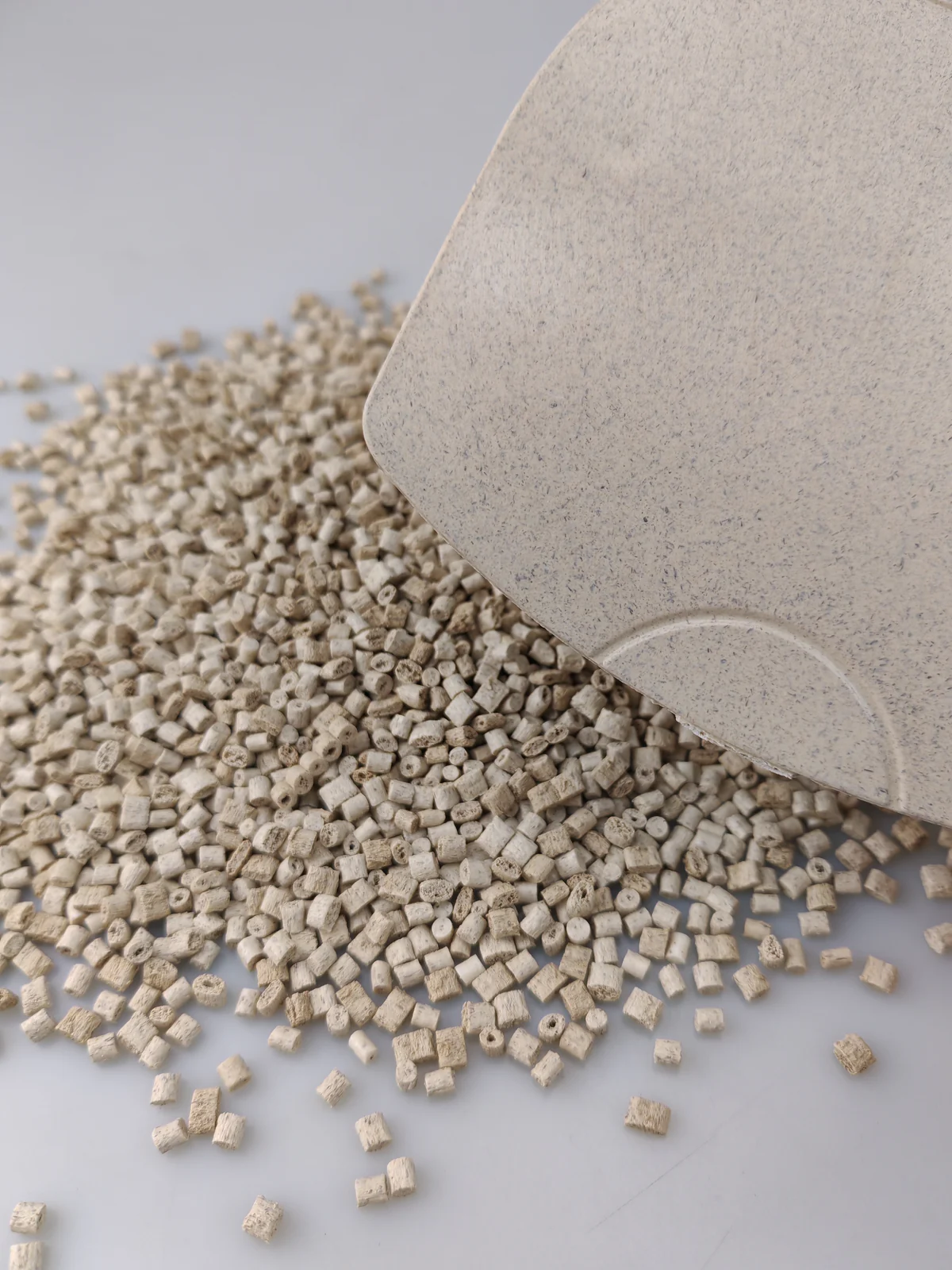
Concentrated plant-fiber masterbatches should not be treated as ready compounds unless the product sheet specifically permits direct molding. High concentration can reduce flow and impact resistance, increase moisture load and produce an appearance or shrinkage response far from the intended finished formulation.
Several current wooyopet PP masterbatches—including tea residue, coffee fiber, coconut coir and red-pine fiber routes—specify at least one part compatible pure PP to one part masterbatch as a starting point. Coconut-fiber PE masterbatch YS60E similarly requires compatible pure PE, not PP, at a minimum 1:1 starting ratio. Increasing the dilution resin to 1:2 or 1:3 may improve flow or toughness and reduce color and particle density, but the result depends on the MFR, impact behavior and additive package of that resin.
Calculate the final plant content from the masterbatch assay and let-down ratio, then test the actual blend. For example, a masterbatch containing 50% plant fraction used at 1:1 with pure resin produces a theoretical 25% plant fraction before other formulation adjustments. Do not report the masterbatch percentage as the final product percentage.
Keep the carrier compatible. A PP masterbatch belongs in a compatible PP matrix unless a separately developed blend is approved. A PE masterbatch should not be dropped into PP merely because both are polyolefins. ABS needs its own compatible system. Carrier mismatch can create delamination, poor weld-line strength, unstable gloss and unexpected impact loss.
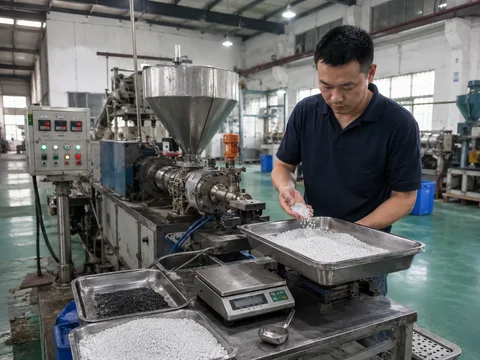
6. Troubleshooting Flash, Short Shots and Brittleness
Flash after adding pure PP
When dilution raises MFR or lowers melt viscosity, an unchanged injection profile can push material through the parting line or vents. First confirm clamp force, mold alignment, wear, parting-line damage and vent depth. Then review peak injection pressure, velocity transition, cushion, packing pressure and packing time. Lowering pressure may help, but it should not hide a damaged mold or remove the packing needed for dimensional control.
Short shots and weak weld lines
Do not automatically raise melt temperature. Confirm drying, feed consistency, shot size, non-return-valve function, gate size, venting and mold temperature. A modest rise in mold temperature or a controlled change in injection speed may improve flow-front joining without adding excessive fiber thermal history. For thin-wall parts, select a compatible dilution resin with an appropriate flow grade rather than forcing a low-flow structural formulation through an undersized gate.
Brittle lids, clips or corners
Plant-filled PP can lose elongation as fiber content rises. Check whether the part is being overpacked, whether the notch radius is too small, whether a weld line sits at the crack, and whether thermal damage or regrind has reduced toughness. A compatible impact-copolymer PP may improve toughness, but it can also change modulus, shrinkage, color, heat resistance and regulatory status. Approve the final blend through molded-part tests.
Silver streaks, black specks and scorched odor
Silver streaks usually send the investigation to moisture, air entrainment, poor venting or contamination. Black specks call for a review of temperature, residence time, dead spots, screw condition, hot-runner balance and previous material. A scorched odor with darkening is a thermal-history warning; a stable natural note without discoloration may be characteristic of an approved formulation. Keep reference plaques and retained batches so production teams do not judge odor from memory.
7. Shrinkage, Density and Cost Must Be Grade-Specific
Plant-filled PP commonly shrinks less and weighs more per unit volume than unfilled PP, but one number should not be assigned to every fiber. Fiber type, loading, orientation, mineral content, base resin, gate location, packing and wall thickness all matter. Published examples already differ: P179302 has a density of 1.11 g/cm³, P179506N 1.14 g/cm³, P179203 1.19 g/cm³, P179002N 1.20 g/cm³ and P179050 1.35 g/cm³.
For mold design, start with the current grade’s published shrinkage range, then mold a geometry representative of the production part and measure flow and transverse directions after defined conditioning. Do not cut steel using a generic 0.8–0.9% value for all plant composites, and do not use the 1.5–2.0% assumption for unfilled PP without trial data.
For purchasing, calculate cost per finished part, not only cost per kilogram. A higher-density compound uses more mass to fill the same volume. The comparison should include material density, runner or hot-runner yield, drying energy, cycle time, scrap, regrind limit, coating or maintenance requirement and the value of the approved surface appearance.
8. Select the Fiber by the Finished Product
Cereal and finely processed wheat-straw PP can provide a pale natural base and controlled small speckles for food-service items, household goods and pet accessories, subject to exact grade compliance. Bamboo-fiber PP and ABS can produce a more linear natural texture and are useful for electronics accessories and household housings where the chosen formulation meets stiffness, impact and dimensional needs.
Wood-fiber PP gives a stronger wood-like identity and can combine high flexural stiffness with visible natural texture for pet chew products, speaker housings, storage items and decorative components. Tea-fiber masterbatch supports a tea-linked color and visual story for packaging inserts, tea accessories and household products. Coffee-ground PP and ABS provide a recognizable brown tone and fine particulate surface for café accessories, trays, packaging components and consumer products.
Natural odor is batch- and process-dependent. Antibacterial, food-contact, compostability and other regulated claims belong to the exact finished formulation and report; they should not be transferred from the raw plant or another grade.
9. Production Start-Up and Shutdown Checklist
| Stage | Control Point | Release Evidence |
|---|---|---|
| Incoming material | Confirm grade, batch, compound versus masterbatch and sealed packaging | COA, label and retained sample match |
| Drying | Use grade-specific temperature and time; control dew point and throughput | Moisture result or approved dry-process record |
| Blending | Verify carrier, let-down ratio, colorant and regrind percentage | Recorded weights and homogeneous blend |
| Plasticization | Start low, control rpm, back pressure and residence time | Uniform purge without black specks or sharp burnt odor |
| Molding | Balance filling, venting, transfer and packing before increasing heat | Approved appearance, weight and critical dimensions |
| Tool protection | Clean cavities and vents, dry surfaces and apply approved protection | Maintenance sign-off and storage condition |
| Machine shutdown | Purge screw, barrel, nozzle and hot runner with a compatible procedure | Clean purge and documented restart condition |
Plant-fiber composite molding becomes repeatable when the material is treated as a defined engineering compound rather than ordinary resin with decorative particles. Dry the exact grade, protect it from moisture pickup, use the lowest stable thermal history, separate masterbatch let-down from compound processing, verify the mold material and maintenance plan, and solve flash or brittleness through a structured defect analysis. Those controls turn a narrow trial window into a stable production window.
Contact
Turn the trial settings into a documented process window
Share your material, part and mold information for grade selection, sampling and production troubleshooting.
- Email: info@wooyopet.com
- WeChat: mkx13905842100
- WhatsApp (DEYU General Reception): +86 13905842100+86 15325909695