
Plant-Fiber PP vs ABS vs PE: Appearance, Performance and Processing Comparison, with a Selection Matrix
Plant-fiber ABS, PP and PE do not overlap in capability: ABS wins on surface and dimensions, PP on heat resistance and compliance, PE on processing breadth and low-temperature toughness. The processing route decides the product form before any property comparison begins.
Buyer and engineer FAQ
Questions before selecting plant-fiber ABS, PP or PE
Which plant-fiber system works for a hollow blow-molded part?
PE. Plant-fiber ABS does not enter blow molding and plant-fiber PP is limited to specific trials, so a coconut-coir PE masterbatch diluted to the right ratio is the only plant-fiber route for hollow bottles, drums, floats and water storage parts. Fix the dilution ratio first, then check parison strength, wall distribution and low-temperature drop performance in the trial.
Can the 4,400 MPa of YS60E be compared with finished ABS and PP grades?
Only at the same fiber loading and test method. YS60E is a 60% fiber masterbatch, so its 4,400 MPa belongs to the concentrate. Ask for the diluted compound sheet and compare stiffness, impact and appearance part by part — ranking a concentrate against a finished grade is the most common misjudgement in PE selection.
Do the 85 °C ABS and 120 °C PP heat-deflection figures decide hot-water use?
Yes for boiling-water contact. Wheat-straw PP holds its shape at 120 °C under 0.45 MPa and takes boiling water directly; ABS at 85 °C under 1.82 MPa suits room-to-medium temperature service and rules out long contact with boiling water or steam. Compare at the same load and confirm on the actual article.
Does FDA + LFGB documentation make every PP part food-contact compliant?
It is the evidence base, not a blanket certificate. Cereal-fiber PP carries FDA + LFGB documentation, and compliance is still confirmed for the actual formulation, batch, destination market and intended food-contact conditions.
For a fast decision, bring the part drawing, target resin family, plant source and fraction, forming route, annual volume, market and pass/fail tests — the engineering team returns a starting grade and the tests to run.
Choosing a plant-fiber compound is not a question of which material is better. It is a question of the fact that the capability boundaries of the three matrices — ABS, PP and PE — do not overlap. ABS-based, PP-based and PE-based compounds form a clear triangular trade-off in appearance, mechanical and thermal performance, and available processing routes: ABS wins on surface and dimensions, PP wins on heat resistance and compliance, and PE wins on the breadth of processing forms and low-temperature toughness. More importantly, the processing route itself pushes the three toward different product forms. ABS is mainly injection molded, PP can be injection molded and extruded, and PE can also be blow molded — which by itself decides which products are not in the candidate range at all.
The comparison below covers appearance, performance and processing, and closes with selection judgements drawn from WOOYOPET's production and sampling projects.
1. Overview: capability comparison of the three plant-fiber systems
| Dimension | Plant-fiber ABS | Plant-fiber PP | Plant-fiber PE |
|---|---|---|---|
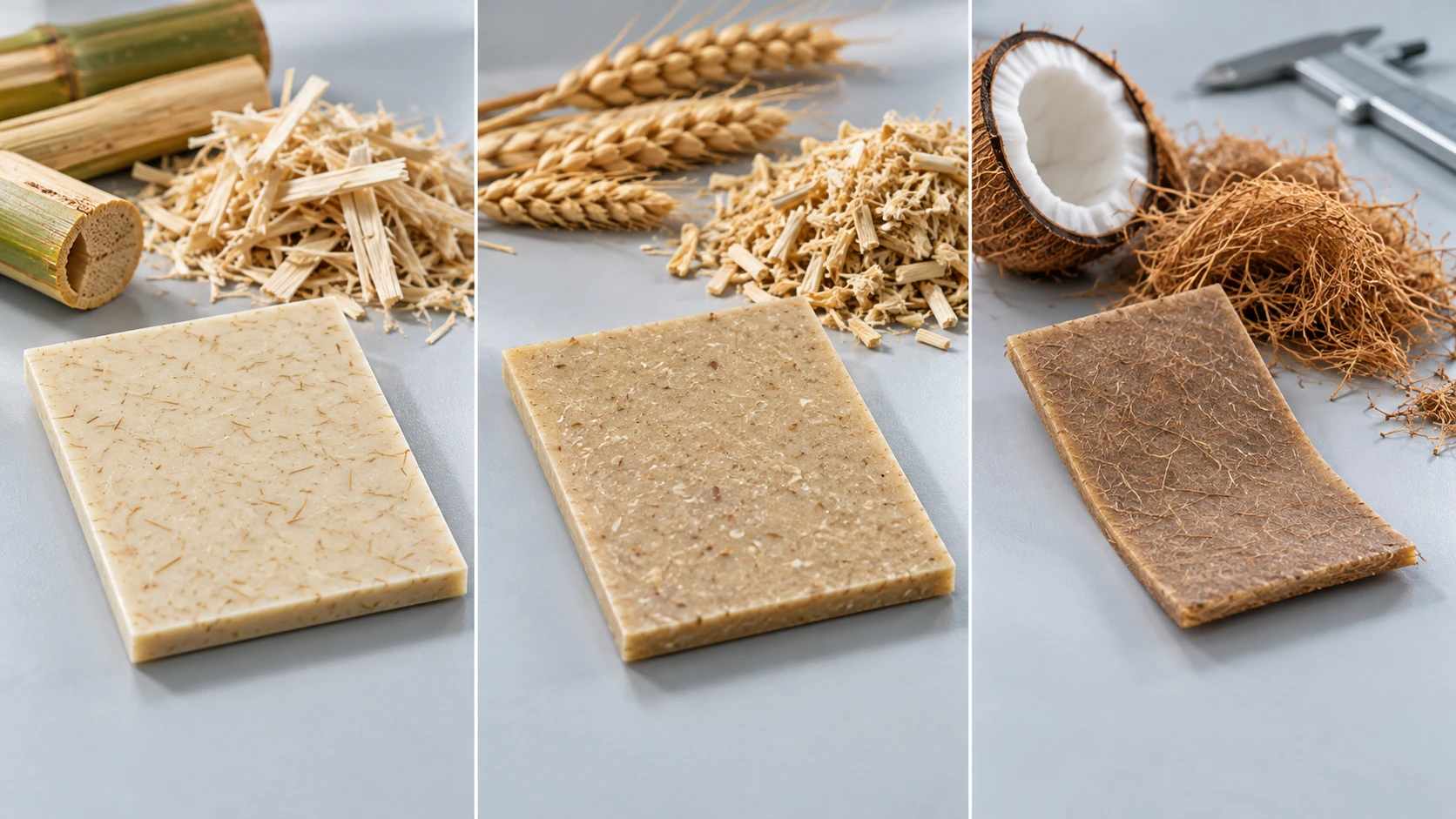
| Representative grades | Bamboo-fiber ABS PA757 234 (A7015WT234S); coffee-ground ABS PA757 520 | Wheat-straw PP P179 002N; tea-fiber PP P179-402N | Coconut-coir PE YS60E (masterbatch) |
| Surface | Fine and controllable gloss, close to engineering plastics | Even but clearly waxy, lower gloss than ABS | Softer, waxy, weak fiber texture |
| Paint-free appearance | Bamboo fiber gives a pale wood tone, coffee grounds a deep brown; both can be used as visible parts | Wheat straw gives a cream tone with visible particles | Depends on masterbatch and let-down ratio; color performance weaker than ABS |
| Flexural modulus | 2,230–2,800 MPa | 1,450–1,956 MPa | 4,400 MPa for the masterbatch; falls clearly after dilution |
| Impact strength | 5–6.8 kJ/m² | 3.8 kJ/m² | 3.9 kJ/m² for the masterbatch; more flexible after dilution |
| Heat deflection temperature | 85 °C (1.82 MPa) | 120–122 °C (0.45 MPa) | Lower than PP |
| Shrinkage (MD) | 0.4–0.6% | 0.9–1.2% | Higher than ABS |
| Low-temperature toughness | Moderate | Moderate | Best of the three |
| Food contact | Coffee-ground ABS is certified | FDA + LFGB dual certification | Formulated to the project |
| Available processing routes | Mainly injection molding | Injection molding + extrusion | Injection molding + extrusion + blow molding |
| Typical product forms | Precision visible parts, multi-cavity small parts, cup lids, stirrers | Pet bowls, tableware, sheet, profiles, large flat parts | Hollow bottles and drums, floats, outdoor fittings, packaging |
Read the table as a triangular trade-off rather than a ranking. No single matrix holds all four positions at once, and the processing row is the one that removes candidates before any property comparison begins.
2. Appearance: who can carry a visible surface
After modification, the appearance gap between the three is wider than in the neat resins, because the hue, particle size and dispersion state of the plant fiber sit directly on the surface of the part. ABS is the only one of the three that reliably carries a visible surface part. Bamboo-fiber ABS PA757 234 has a fine surface and a gloss that can be adjusted between matte and semi-gloss through mold temperature; with even fiber dispersion the particles are almost invisible, and the surface comes close to a conventional ABS visual part. Coffee-ground ABS PA757 520 gives a deep brown matte surface with no paint or dye needed for visual recognition — which is the direct reason it was selected for stirrer and cup-lid projects with a European coffee chain: the customer wanted it to look like coffee grounds, not to hide them.
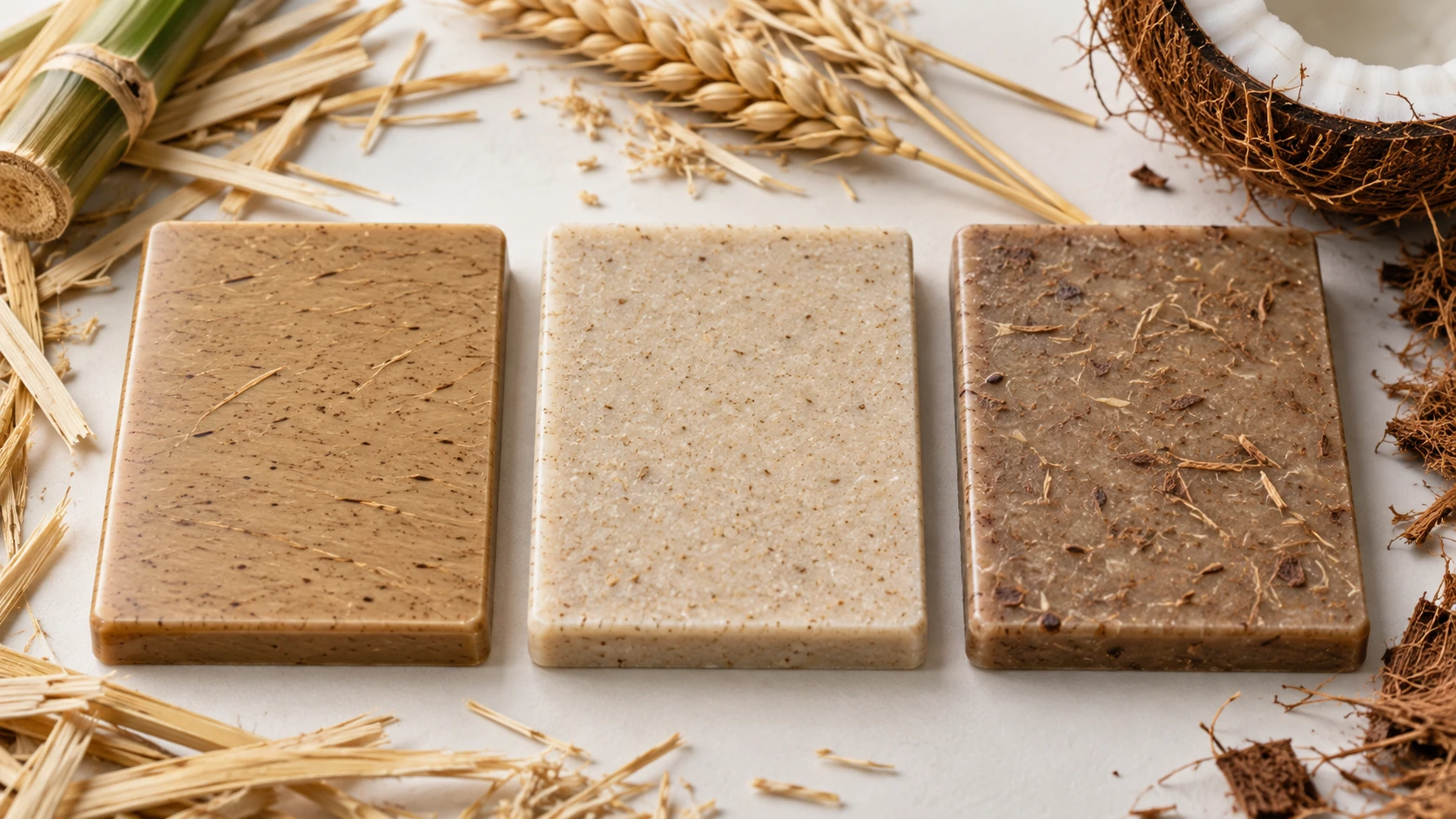
PP is honest about what it is. Wheat-straw PP P179 002N is cream colored with fine surface particles, an obvious waxy feel and lower gloss than ABS. On pet bowls and tableware handles, the light wheat aroma and the visible fiber particles become selling points on the product page; but if the product is positioned as a high-end visible part, the PP surface becomes the weak point. Tea-fiber PP gives a pale tea tone and a softer visual, but it does not reach the gloss capability of ABS either.
PE has the weakest appearance and depends heavily on the let-down ratio. Coconut-coir PE YS60E is supplied as a 60% fiber masterbatch, so fiber visibility, surface evenness and hue consistency in the finished part depend on the dilution ratio and the base polymer. The outer surface of a blow-molded hollow part is relatively smooth, but the inner surface and the fiber texture are less controllable than in an injection-molded part. PE is not suited to products whose selling point is surface quality; its value is not in appearance.
3. Performance: the four-way trade-off between stiffness, heat, toughness and dimensions
After modification, the performance differences between the three are essentially a trade-off among stiffness, heat resistance, toughness and dimensional stability. No single matrix takes all four. ABS leads on stiffness, PP sits in the middle, and PE falls to last place after dilution. Bamboo-fiber ABS reaches a flexural modulus of 2,800 MPa and coffee-ground ABS 2,230 MPa; wheat-straw PP reaches 1,956 MPa and tea-fiber PP falls to 1,450 MPa; coconut-coir PE shows 4,400 MPa in the masterbatch, apparently the highest figure, but that is a 60% fiber concentrate — diluted to a normal injection-molding or blow-molding ratio, its flexural modulus falls clearly below the PP compounds. Comparing a masterbatch TDS against the finished properties of PP and ABS is the most common misjudgement in PE selection.
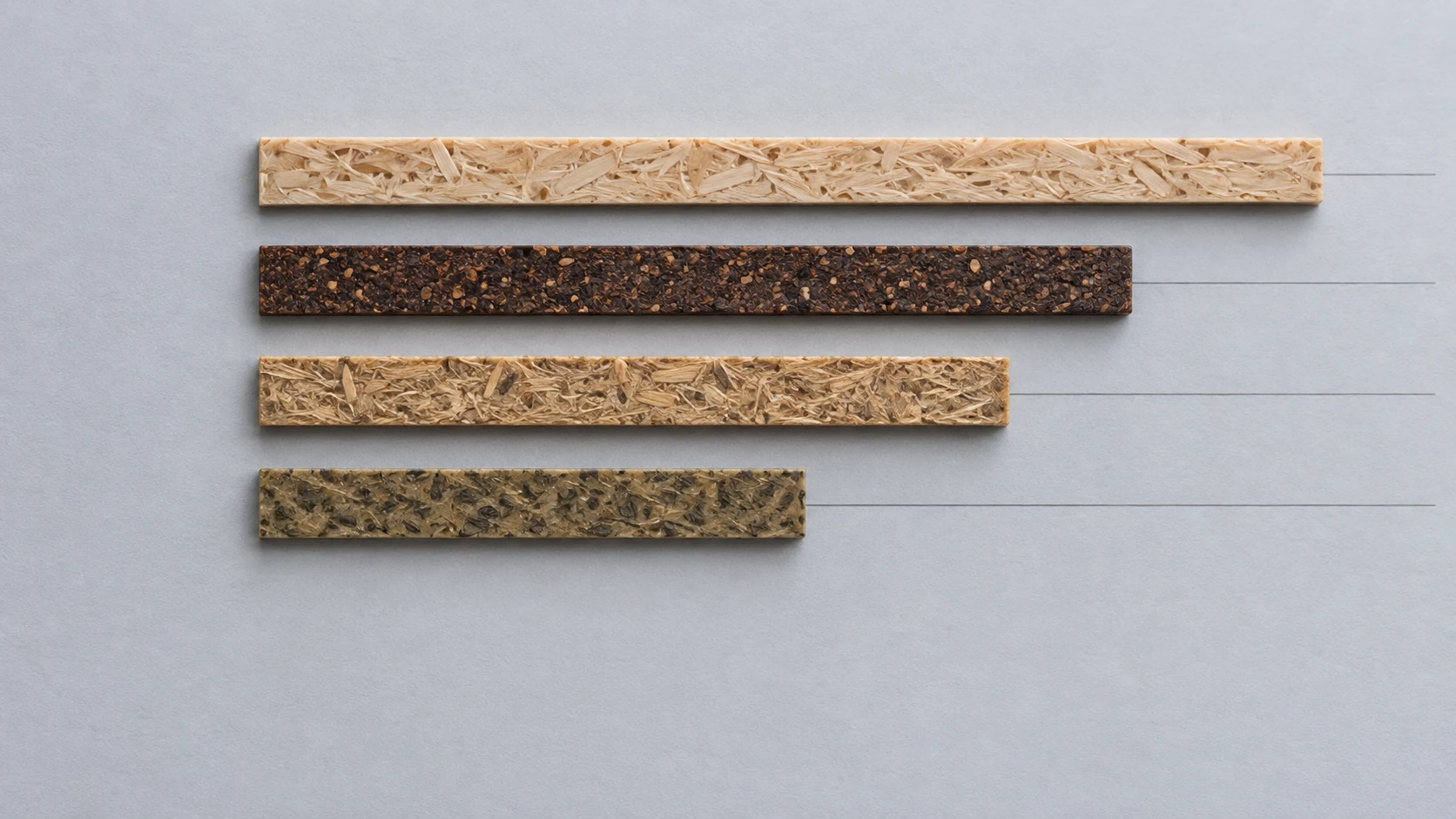
On heat resistance, PP is the only one of the three that can take boiling water reliably. Wheat-straw PP reaches a heat deflection temperature of 120 °C at 0.45 MPa and does not deform when boiling water is poured in; ABS reaches 85 °C at 1.82 MPa, which suits room-temperature to medium-temperature use and rules out long contact with boiling water or steam; PE sits below PP. For pet bowls, tableware and everyday items that are washed with hot water, the heat advantage of PP is decisive.
On toughness, PE has the best low-temperature performance and coffee-ground ABS the best room-temperature impact. Coffee-ground ABS reaches 6.8 kJ/m², a relatively tough grade within the ABS family; bamboo-fiber ABS stands at 5 kJ/m² and wheat-straw PP at 3.8 kJ/m². The value of PE is not in its room-temperature impact number but in holding toughness at low temperature — in refrigerated use, winter outdoor use and drop-resistant parts, PE is the only one of the three that does not become clearly brittle in the cold.
On dimensional stability, the 0.4–0.6% shrinkage of ABS is the hardest lever in the matrix. The 0.9–1.2% shrinkage of PP turns directly into warpage risk and yield pressure on multi-cavity precision molds and large thin-wall flat parts. PE shrinkage is usually higher than ABS, and the wall-thickness control logic of blow molding is different from injection molding, so dimensional precision is not its strength.
4. Processing: the route defines the product form
This is the most underrated difference between the three materials. The processing route is not just "how the part is formed" — it is "what products can be made".
| Route | Plant-fiber ABS | Plant-fiber PP | Plant-fiber PE |
|---|---|---|---|
| Injection molding | ✔ Main route | ✔ | ✔ |
| Extrusion | Rare | ✔ Sheet, profiles, pipe | ✔ Sheet, profiles |
| Blow molding | ✘ | Limited | ✔ Hollow bottles, drums, floats |
| Typical forms | Precision small parts, multi-cavity parts | Injection-molded daily goods + extruded large flat parts | Hollow parts + extruded parts + injection-molded parts |
ABS is mainly injection molded. With an MFR of 7.5–8.5 g/10 min its flow suits multi-cavity precision molds, and the coffee-ground ABS stirrer project held the cycle below 25 seconds in a multi-cavity tool. The strength of ABS is the high precision and high surface quality of injection-molded parts, but its product forms are essentially locked to injection molding; extrusion and blow molding are not its battlefield.
PP can be injection molded and extruded. On the injection side it covers everyday goods such as pet bowls and tableware handles; on the extrusion side it makes sheet, profiles and pipe, suiting large flat and continuous-length products. The injection window of wheat-straw PP is mature: a mold temperature of 65 °C, an injection speed about 15% lower than conventional PP and 2 seconds more packing are enough for stable production, and the extrusion side benefits from the melt strength and fiber dispersion of the PP matrix. If the product is sheet, profile or a continuously extruded form, PP is the best of the three at covering both injection molding and extrusion.
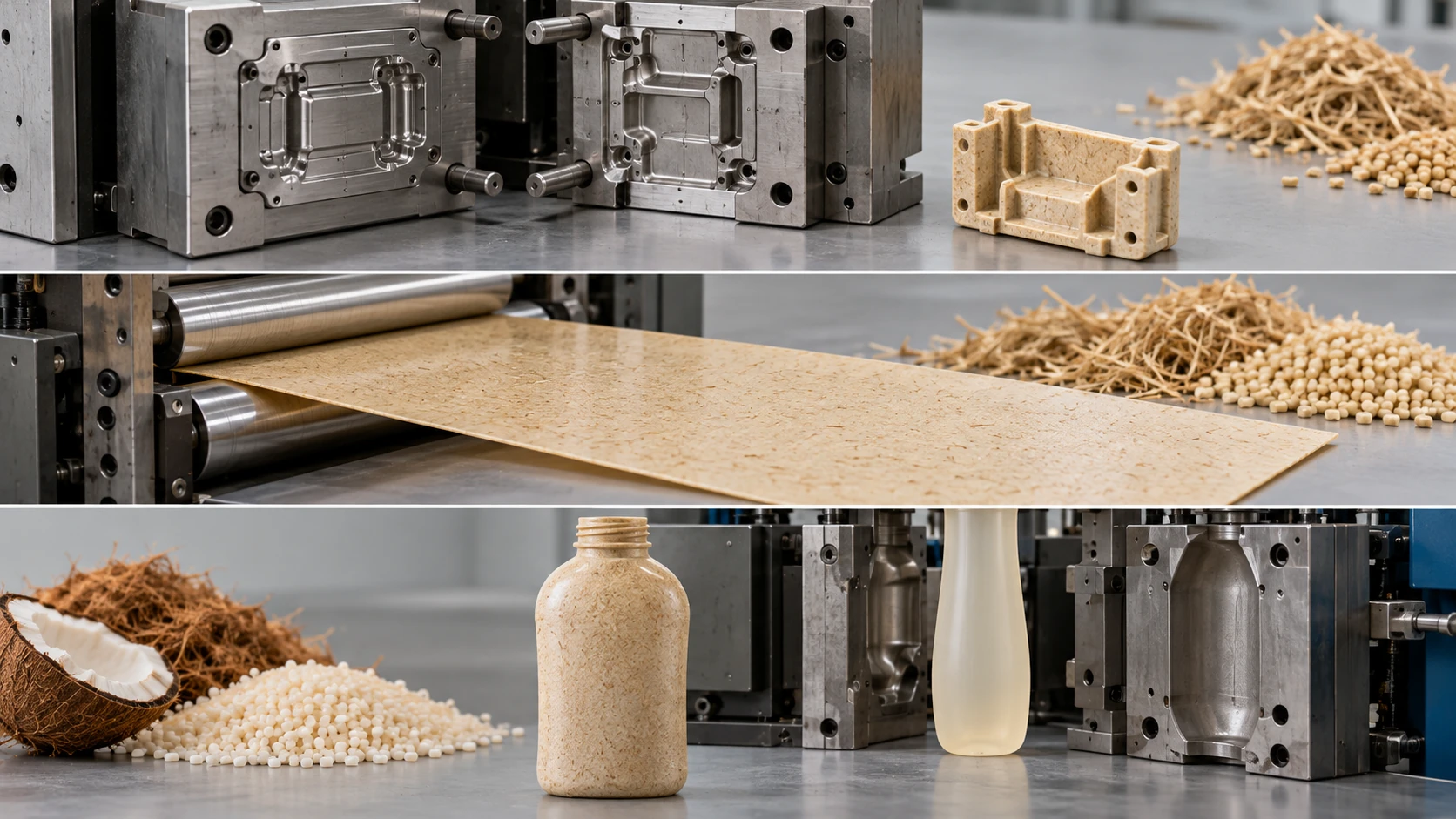
The unique value of PE is blow molding. Injection molding, extrusion and blow molding are all available, and blow-molded hollow parts are the field that plant-fiber ABS and PP basically do not enter. Coconut-coir PE masterbatch has an MFR of 3.18 and, after dilution, suits blow molding for hollow bottles, drums, floats and water storage parts. This means that if the product form is a hollow article, plant-fiber ABS and PP are simply not on the candidate list from the start — PE is not the fallback, it is the only workable plant-fiber route.
The constraints shared by all three belong in the selection as well: plant-fiber compounds flow less well than neat resin, so small molds need attention to gate blocking, and plant fiber can decompose during melt processing and release acidic species, so stainless molds are recommended — conventional molds will corrode and score over long use. These constraints exist on all three matrices, but high-fiber systems such as the undiluted PE masterbatch carry a higher corrosion load, and the mold upgrade cost should be budgeted at the start of the project.
5. Customer cases: how the three materials performed in real projects
Case 1: wheat-straw PP pet bowl (injection molding, in production since 2025)
The material has a flexural modulus of 1,956 MPa and a heat deflection temperature of 120 °C at 0.45 MPa; the production yield stayed above 96% and no warpage or deformation complaints reached the customer. The injection parameters were set to a mold temperature of 65 °C, an injection speed 15% lower than conventional PP and 2 seconds more packing time. The brand made "wheat-straw plant-based material" the core selling point of its product page, and consumers responded well to the light wheat aroma. Selection lesson: PP has a mature process window for injection-molded everyday goods, and heat resistance plus food compliance form a double barrier — production starts without new equipment or mold changes.
Case 2: coffee-ground ABS stirrers (injection molding, exported to a European coffee chain)
An MFR of 7.5 g/10 min, a flexural modulus of 2,230 MPa and an impact strength of 6.8 kJ/m², with the cycle in a multi-cavity mold held below 25 seconds. The core challenge in production was batch consistency: WOOYOPET held the MFR of every batch within 7.2–7.8 g/10 min and kept shrinkage variation narrow to meet the even filling requirement of the multi-cavity tool. Selection lesson: in multi-cavity precision mold work, the 0.4–0.6% shrinkage of ABS converts directly into a yield advantage, while the 0.9–1.2% shrinkage of PP needs tighter incoming-material control to compensate.
Case 3: coconut-coir PE outdoor pet water reservoir (blow molding / injection sampling)
The customer's product is a hollow water reservoir that must be flexible, tolerate low temperatures and be blow moldable. Plant-fiber ABS and PP are not blow-moldable in that product form, so PE was the only plant-fiber route that entered sampling. The sampling stage focused on the finished properties after dilution, on wall-thickness evenness in blow molding and on low-temperature drop performance. Selection lesson: once the product form is fixed as a hollow blow-molded part, the selection logic is not "compare the three materials" — the processing route first narrows the field to PE, and the dilution ratio and matrix formulation are then evaluated inside the PE route.
6. Selection path by product form and failure boundary
Step 1 — narrow the field with the processing route. Precision injection-molded small parts and multi-cavity visible parts → ABS first; injection-molded everyday goods, sheet, profiles and large flat parts → PP first; hollow blow-molded parts, bottles, drums, floats and water storage parts → PE is the only workable route. If the route does not fit, comparing properties is meaningless.
Step 2 — fix the non-negotiable performance boundary inside the remaining field. Visible parts, assembly parts and multi-cavity precision parts → the shrinkage and surface quality of ABS are a hard advantage; boiling-water contact, food contact and an FDA + LFGB evidence chain → heat resistance and compliance maturity make PP the shortest path; low-temperature toughness, drop resistance and outdoor weathering → the matrix flexibility and low-temperature behaviour of PE cannot be replaced.
Step 3 — put mold and process adaptation cost into the comparison. The acidic decomposition products of plant fiber require corrosion protection on the mold steel, and keeping fiber length requires a screw configuration that does not over-shear. If the existing mold is ordinary steel and will not be replaced, low-fiber or surface-treated grades carry a more controllable corrosion load; high-fiber systems require the mold upgrade to be counted in the total cost.
Step 4 — separate "cost per kilogram" from "cost per compliant part". A cheaper PP matrix does not make a cheaper compound: at 30% fiber loading the unit cost can rise rather than fall. The ABS matrix is more expensive, but the cost-down direction of fiber filling and the stiffness premium can both be realised on the same part. In food-contact work, the mature FDA + LFGB evidence chain of PP saves testing time and cost, and that belongs in the economics of the selection.
Selection summary: plant-fiber ABS buys surface quality and a shrinkage baseline; plant-fiber PP buys heat resistance, food compliance and the process breadth of injection molding plus extrusion; plant-fiber PE buys the hollow blow-molded form and low-temperature toughness. The comparison is not a property ranking on one product — the processing route first draws the boundary of the product form, and the failure boundary then decides the matrix. For property sheets, diluted finished-part data or production selection support, contact the WOOYOPET team.
Data notes
Property figures above come from the WOOYOPET public grade pages for A7015WT234S, PA757520, P179002N, P179-402N and the YS60E masterbatch. Test methods, fiber treatment and base resin differ between those grades, so the values describe each grade and are not a controlled experiment on the base resin alone. The YS60E figures belong to the 60% fiber masterbatch; finished-part properties after dilution must be measured again. Production figures in the three cases come from WOOYOPET's 2025 production and sampling projects and describe those projects.