
Wheat Straw PP vs. Grain Fiber PP: Selecting WYC-PP P179002N or P179050 for Disposable Food Container Injection Molding
A practical grade-selection guide for food-contact containers, based on fiber source, molded appearance, verified properties, processing behavior, and production yield.
Buyer and engineer FAQ
Questions engineers ask when comparing P179002N and P179050
Should a light-colored food-contact container use P179002N or P179050?
Prioritize P179002N. Its finer grain fiber produces a more uniform off-white matte surface, while its 31 MPa tensile strength, 120°C HDT and FDA/LFGB food-contact test support fit the application. P179050 is better reserved for dark or non-appearance parts where coarse wheat-straw points are acceptable.
Why is P179050’s higher MFR not enough to make it the better thin-wall grade?
P179050 flows more readily at 15 g/10 min, but the customer trial showed that flow only solved filling. Coarser fiber dispersion still caused blue-gray points, weld lines, warpage and unstable lid engagement. Switching to P179002N reduced those defects and raised production yield from about 82% to 96%.
Can injection-molding adjustments remove the coarse blue-gray points in P179050?
Not completely. Drying at 105°C for four hours, medium-low injection speed, higher holding pressure and lower back pressure improved weld lines and warpage, but could not eliminate the surface effect caused by mixed, coarse wheat-straw fiber. The light-color requirement ultimately required a material change to P179002N.
Which data should purchasing compare before approving P179002N or P179050?
Compare fiber source and plant section, ash control, exact FDA/LFGB migration-test scope, batch color-difference limits, shrinkage data, density and part-specific molding parameters. Density matters commercially: P179050 is 1.35 g/cm³ versus 1.20 g/cm³ for P179002N, so the same-volume part consumes about 12.5% more material.
For a precise grade recommendation, share the part drawing, wall thickness, mold structure, food-contact target, color requirement and current processing window with wooyopet.
Why Plant-Fiber PP Is More Than “Adding Fiber”
One of the questions wooyopet receives most often from purchasing teams and injection-molding engineers is: what is the real difference between wheat-straw PP and grain-fiber PP? Both are plant-fiber PP composites, and both may be described with terms such as bio-based content, plastic reduction, or food-grade PP food-container material. But once the material reaches disposable food containers, cutlery, and daily-use products, differences in fiber source, molded appearance, food-contact compliance, and processing window become much more visible.
This guide compares two wooyopet grades from an engineering perspective: WYC-PP P179002N grain-fiber PP and WYC-PP P179050 wheat-straw PP. It is intended for buyers and process engineers evaluating food-contact PP containers, plant-fiber PP injection molding, or a practical purchasing specification.
Demand for disposable food containers remains high while plastic-reduction policies continue to advance. The global polypropylene disposable food-container market was valued at approximately USD 18.6 billion in 2025 and is projected to reach USD 33.63 billion by 2035, a compound annual growth rate of 6.1%. China leads the Asia-Pacific market through its large food-service and delivery ecosystem. Against this background, plant-fiber PP has emerged as a compromise: it preserves PP’s processing window and heat resistance while replacing part of the petroleum-based content with plant fiber.
The difficulties are equally concentrated. Fiber sources can vary, creating batch-to-batch color differences. Ash and impurities directly affect appearance. Coarse fiber that is poorly dispersed creates pitting and blue-gray specks, especially on light-colored containers. Food-contact documentation may not transfer from one fiber source to another. Shrinkage, warpage, and weld lines become harder to control, while insufficient drying of hygroscopic fiber can produce bubbles and silver streaks.
wooyopet’s approach is not simply to mix straw or grain powder into PP. Fiber section, fineness, ash, compatibilization, drying, and the molding window are matched as one system.
Core Differences Between Wheat-Straw PP and Grain-Fiber PP
Similar Plant Origin, Different Fiber Sections
Wheat-straw PP generally contains a more varied feedstock. Roots, stems, and leaves can enter the collection stream, increasing coarse fiber, ash, and impurity variation. Coarse fibers are more likely to remain visible after molding. Wheat-straw fiber is relatively long and rigid, which can raise flexural modulus and heat resistance, but it also creates a rougher surface and is harder to disperse in PP. The compound becomes more sensitive to barrel temperature and screw shear.
wooyopet’s grain-fiber PP follows a finer-fiber route. The raw-material selection favors tender stalk sections and reduces aged material and hard nodes, producing finer and more uniform fibers. This distinction strongly influences molded appearance and the difficulty of maintaining food-contact compliance.
Surface Appearance: Coarser Specks Versus a Fine Matte Finish
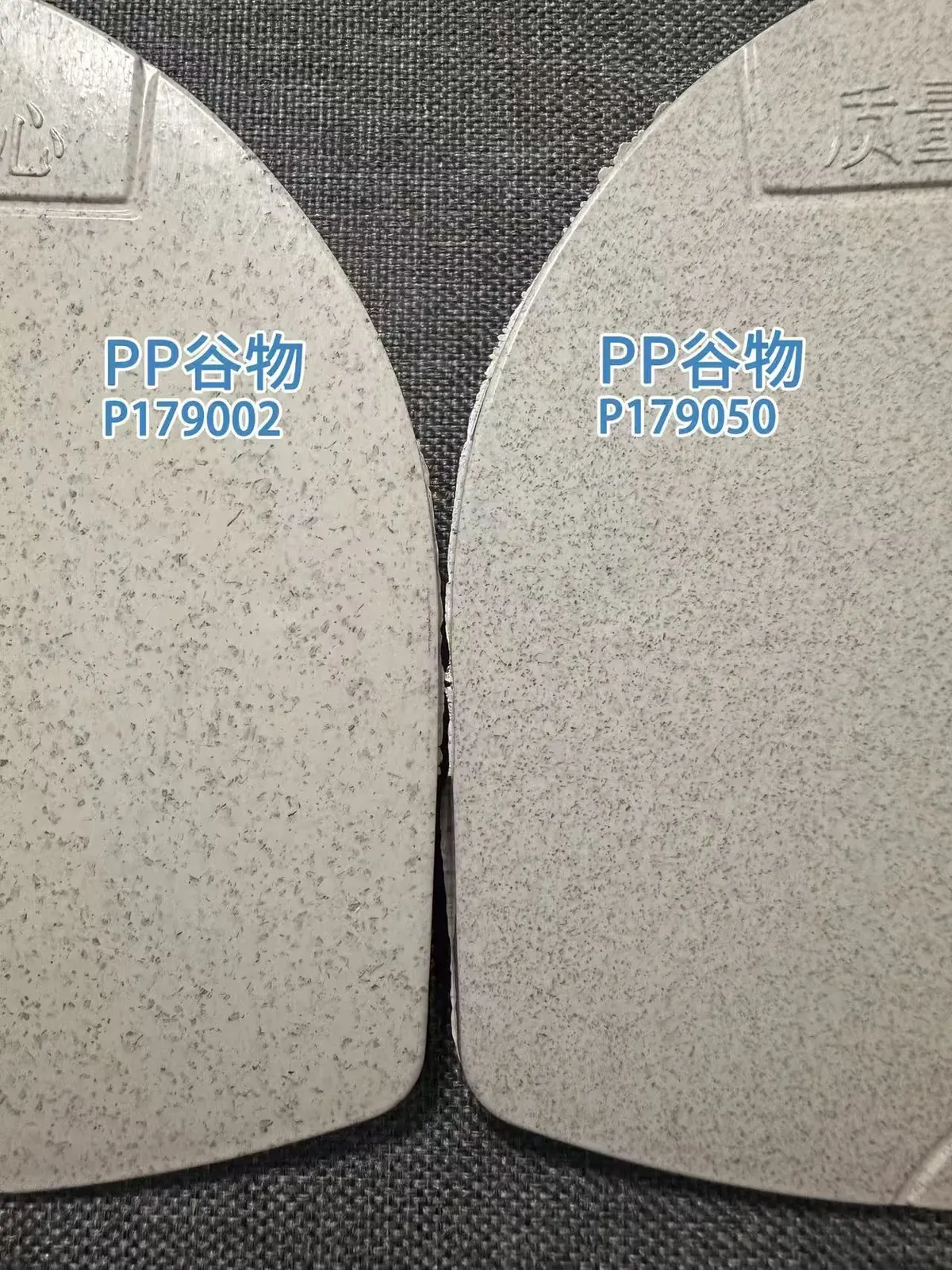
After injection molding, wheat-straw PP is more likely to show coarse fiber points and a visible blue-gray cast. On light-colored food containers these marks become especially obvious. If mold temperature, injection speed, and drying are not matched, weld lines, color variation, and localized mottling can also appear. Thermal oxidation of lignin and ash during high-temperature molding contributes to the effect, so machine adjustment alone cannot eliminate it.
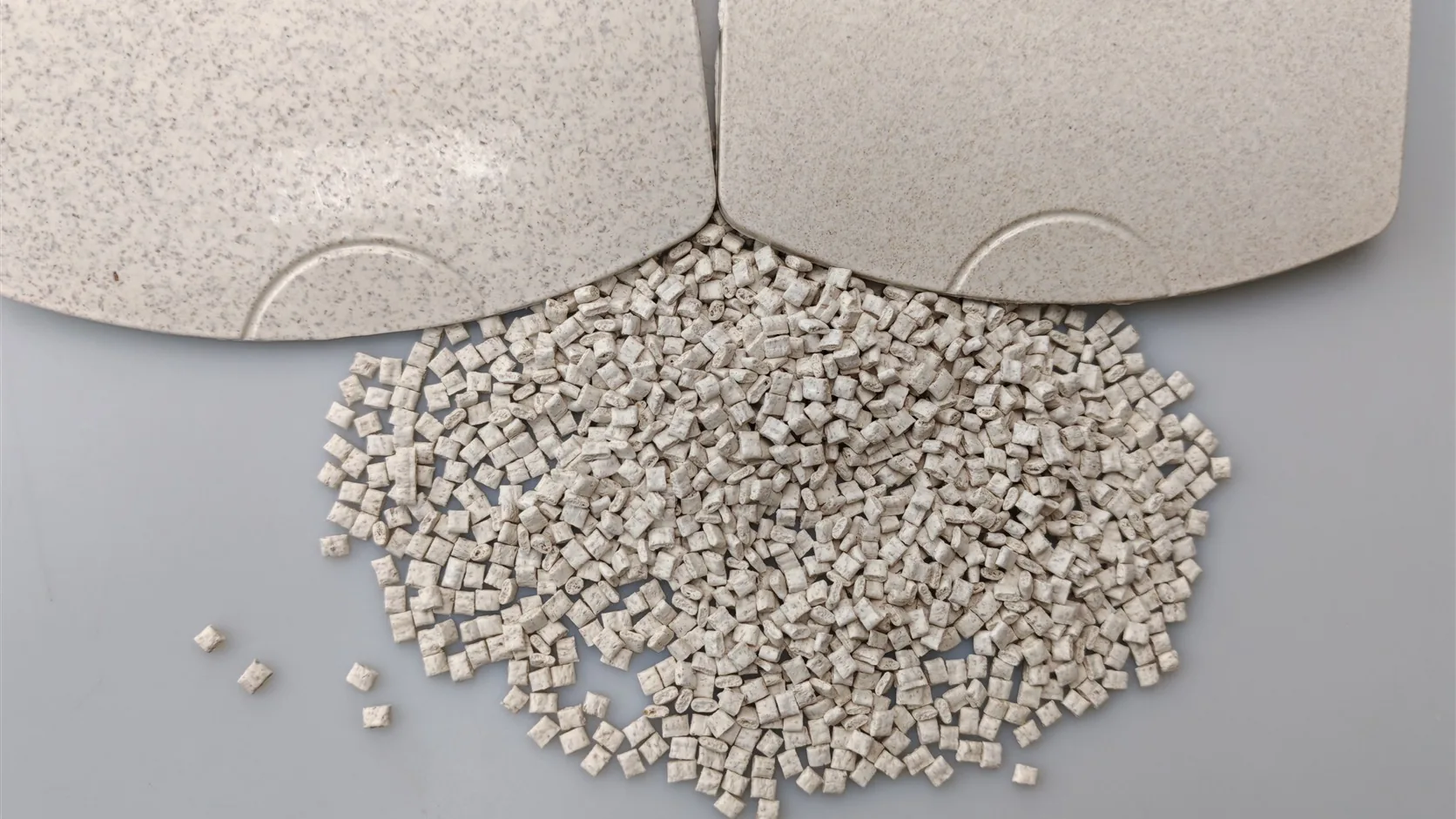
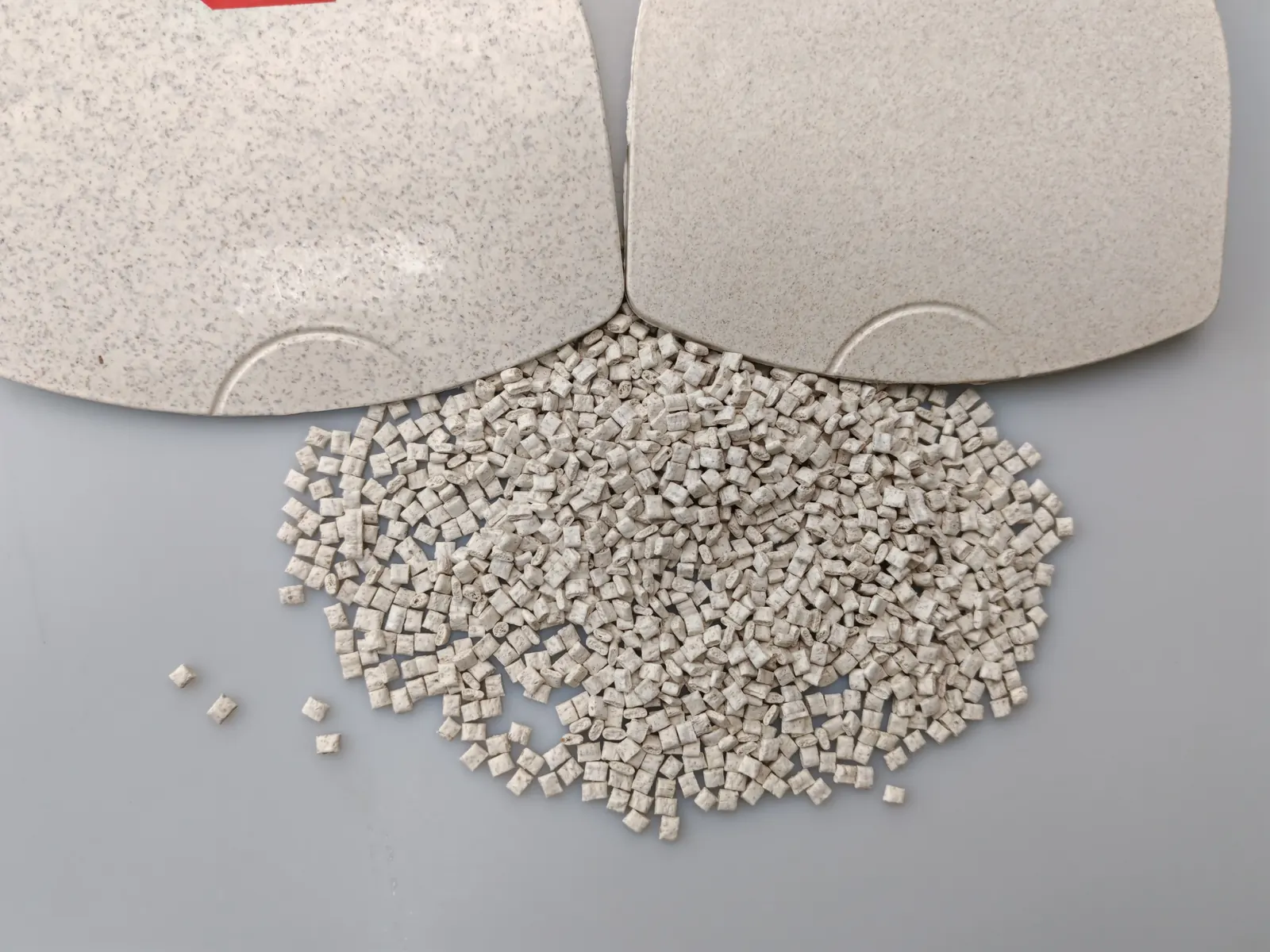
Grain-fiber PP contains finer fiber and produces a more delicate surface after dispersion. Its base color is closer to off-white, making it suitable for light-colored disposable food containers, trays, knives, forks, and spoons. P179002N produces a fine off-white matte surface with a subtle natural texture that looks closer to a frosted finish than ordinary plastic.
Food-Contact Compliance: Grain-Fiber PP Is Easier to Control
Food-contact materials are evaluated for odor, migration, heavy metals, ash, and impurities. Research on plant-fiber food-contact materials has found little or no release of target trace elements from some coconut-shell, straw, and wheat-based samples, while materials made from bagasse, bamboo, and palm leaf released detectable arsenic, cadmium, or lead, with lead the most frequent migrating element.
Because wheat straw may contain mixed root, stem, and leaf fractions, pretreatment is more difficult and the background level of ash and heavy metals can vary more from batch to batch. A fine, low-ash grain-fiber route based on selected tender stalks, food-contact additives, and a controlled compatibilization system is easier to validate. wooyopet P179002N has passed FDA and LFGB food-contact testing, which is a major reason to prioritize it for light-colored food-contact containers.
wooyopet’s Four-Step Technical Route
- Raw-material sorting. Wheat straw is screened in multiple stages to remove impurities and control the ratio of roots, stems, and leaves. Grain fiber is selected from tender stalk sections to reduce hard nodes and ash.
- Fiber refinement and surface treatment. Fiber length and dispersion are controlled to reduce coarse points. Fibers that are too long obstruct flow and roughen the surface; fibers that are too short lose reinforcement efficiency.
- Compatibilization and dispersion. A tailored compatibility system improves the interface between hydrophilic plant fiber and the PP matrix, balancing stiffness and toughness.
- Drying and processing-window matching. Because plant fiber absorbs moisture, inadequate drying directly causes bubbles, silver streaks, and strength loss. Each grade is supplied with a defined drying and barrel-temperature window.
WYC-PP P179002N and P179050: Key Data Comparison
The following values come from wooyopet product data and provide a selection reference for buyers and molding engineers.
| Property | WYC-PP P179002N Grain-Fiber PP | WYC-PP P179050 Wheat-Straw PP |
|---|---|---|
| Specific gravity | 1.20 g/cm³ | 1.35 g/cm³ |
| MFR, 230°C/2.16 kg | 9.5 g/10 min | 15 g/10 min |
| Tensile strength | 31 MPa | 18 MPa |
| Flexural strength | 55 MPa | 34 MPa |
| Flexural modulus | 1,956 MPa | 2,000 MPa |
| Notched Izod impact, 23°C | 3.8 kJ/m² | 3.1 kJ/m² |
| HDT, 0.45 MPa | 120°C | 125°C |
| Melting point | 170°C | 160°C |
| Shore hardness | 73 HD | 73 HD |
| Processing reference | Dry 100–120°C for 4–5 h; rear barrel 155–165°C; middle/front/nozzle 160–175°C; mold 70–80°C | Same reference window |
P179002N combines a flexural modulus of 1,956 MPa, tensile strength of 31 MPa, and an HDT of 120°C at 0.45 MPa. Its MFR of 9.5 g/10 min provides medium-high flow while preserving rigidity, allowing both thicker structural parts and moderately thin walls without making short shots likely. Its 0.9%–1.2% shrinkage range supports stable dimensions and reduces warpage.
P179050 has a higher MFR of 15 g/10 min and can suit dark parts, non-appearance components, or thin walls requiring very high flow. Its tensile strength is 18 MPa and flexural strength is 34 MPa. At 1.35 g/cm³, it is 12.5% heavier than P179002N, so a part of the same volume consumes more material—an important cost factor that is often missed in purchasing comparisons.
Customer Case: Injection Molding a Light-Colored Disposable Food Container
An East China disposable food-container manufacturer, anonymized here as Customer A, planned a light-colored container requiring food-contact compliance, a fine surface, heat resistance, and stable lid engagement. The initial trial used P179050 because its 15 g/10 min MFR appeared favorable for a thin-walled container.
Initial Problems
The initial settings were approximately 110°C drying for four hours; rear, middle, front, and nozzle temperatures of 160°C, 170°C, 170°C, and 170°C; and a 75°C mold. The trial showed coarse fiber points, a blue-gray cast, and batch color variation. Weld lines were deep, some edges were underfilled, the container warped, and the lid did not close consistently. Food-contact documentation also had to be rematched because the customer was concerned about variation in the straw source. Production yield was only about 82%.
The customer’s technical review identified the original mistake: good flow can fill a thin wall, but fiber dispersion and thermal stability determine appearance and yield. Flow solved filling but not the surface or dimensional-stability problems.
Two-Step Adjustment
First, wooyopet’s application engineer optimized the P179050 window after checking moisture, MFR, and shrinkage. Drying was changed to 105°C for four hours, the mold was stabilized at 75°C, injection was slowed to a medium-low speed, holding pressure was raised, and back pressure was reduced. Weld lines and warpage improved, but the blue-gray and coarse fiber points still failed the light-color appearance requirement. This confirmed that the principal surface limitation was inherent to the material route.
Second, the project switched to P179002N. The recommended settings were 105°C drying for four hours; rear, middle, front, and nozzle temperatures of 160°C, 170°C, 172°C, and 170°C; and a 75°C mold. With an MFR of 9.5 g/10 min, tensile strength of 31 MPa, flexural strength of 55 MPa, notched impact strength of 3.8 kJ/m², 120°C HDT, and 170°C melting point, the grade provided a better balance of stiffness, toughness, and appearance. No injection-machine modification was required.
Result
After the switch, the surface became visibly finer, blue-gray points decreased, weld lines became shallower, and lid engagement stabilized. Production yield rose from approximately 82% to 96%. Food-contact testing met the relevant FDA requirements. Customer A now uses P179002N for light-colored food-contact containers and retains P179050 for dark or non-appearance parts. The lesson is not that one grade is universally better: fiber type defines the application boundary.
| Project Stage | Material and Setting | Observed Result |
|---|---|---|
| Initial trial | P179050; dry 110°C/4 h; 160/170/170/170°C barrel and nozzle; mold 75°C | Coarse blue-gray points, deep weld lines, warpage, unstable lid fit, about 82% yield |
| P179050 optimization | Dry 105°C/4 h; medium-low injection speed; higher holding pressure; lower back pressure | Warpage and weld lines improved, but inherent surface points remained |
| Material switch | P179002N; dry 105°C/4 h; 160/170/172/170°C; mold 75°C | Finer surface, fewer gray points, stable lid fit, 96% yield, FDA-related test requirements met |
Purchasing and Engineering Selection Guide
| Application Requirement | Preferred Direction | Reason |
|---|---|---|
| Light color, food contact, and demanding appearance | WYC-PP P179002N | Fine off-white matte surface, 31 MPa tensile strength, 120°C HDT, FDA/LFGB testing |
| Dark, non-food-contact, cost-sensitive, or very high-flow part | WYC-PP P179050 | 15 g/10 min MFR; suitable where coarse points and color are less critical |
| Daily-use structural part needing stiffness and heat resistance | P179002N | Better tensile/flexural strength and dimensional stability |
| Natural fiber texture and tactile character | Either grade after appearance trial | Both retain a matte plant-fiber texture; P179002N is finer and more uniform |
Buyers should ask which plant section supplies the fiber and how ash is controlled; request the exact FDA or LFGB test items and limits rather than accepting a generic “certified” statement; define a ΔE color-difference limit and batch-retention procedure; request parameters matched to the actual wall thickness and mold; and review shrinkage by batch. P179002N’s MD shrinkage is 0.9%–1.2%, and the absence of comparable batch data is a warning sign for dimensional risk.
For both grades, the general reference is 100–120°C drying for four to five hours; rear barrel 155–165°C; middle, front, and nozzle 160–175°C; and mold 70–80°C. Settings should be adjusted for the machine, mold, and finished-part requirements.
wooyopet’s role is not limited to supplying a grade. The objective is to make plant-fiber PP stable in injection molding, verifiable for food contact, and controllable in appearance. Buyers evaluating wheat-straw PP or grain-fiber PP can contact wooyopet for samples, part-specific molding recommendations, and food-contact compliance documentation.