
Are Plant-Fiber Composite Plastics Biodegradable or Non-Biodegradable?
Bio-based content describes where material comes from. Biodegradability describes what microorganisms can do to its molecular structure under defined conditions. A buyer must evaluate both.
Buyer and engineer FAQ
Questions buyers ask about plant-fiber plastics and degradation
Does adding plant fiber make polypropylene biodegradable?
No. The plant fraction may biodegrade under suitable conditions, but the continuous PP matrix remains conventional polypropylene unless the finished formulation has a separately demonstrated degradation route. Fiber content alone cannot support a biodegradable claim.
Will ordinary PLA disappear in soil or a home compost bin?
Not reliably. Most commercial PLA compostability claims depend on controlled industrial conditions with elevated temperature, moisture, aeration and microbial activity. A product needs evidence for the exact receiving environment; industrial-compost certification does not prove home-compost or open-soil performance.
Does an ASTM D5511 result certify a product as landfill biodegradable?
No. ASTM D5511 is a laboratory test method for high-solids anaerobic digestion. It reports the measured conversion of sample carbon to gaseous carbon over the actual test period. It does not create an unrestricted biodegradability claim or guarantee the same result in every landfill.
Can additive dosage alone establish a degradation percentage?
No. Dosage can define a formulation starting point, but the claim must come from the finished compound or finished article tested under the stated method, duration and conditions. Resin grade, fiber loading, pigment, wall thickness and processing history can all affect the result.
What evidence should accompany a bio-based claim?
State the exact renewable fraction and the measurement or mass-balance method used. For a plant-filled PP compound, distinguish physical plant-fiber content from measured bio-based carbon content, and never use “bio-based” as a synonym for biodegradable or compostable.
For a defensible specification, define the resin, plant fraction, intended disposal route, target market, test method, acceptance threshold and finished article before selecting the environmental claim.
This is one of the questions purchasing teams ask most often, and it is also one of the easiest to answer incorrectly. “Plant-based,” “bio-based,” “biodegradable” and “compostable” describe different things. A material can satisfy one description without satisfying the others.
Bio-based content concerns feedstock origin: how much of the material or its carbon comes from biomass rather than fossil resources. Biodegradability concerns molecular structure and a biological process: whether microorganisms can convert the organic constituents into carbon dioxide, water, biomass and mineral salts, or methane when oxygen is absent, under defined conditions and within a measured period. Compostability is narrower again because it requires biodegradation, disintegration and quality criteria in a managed composting system.
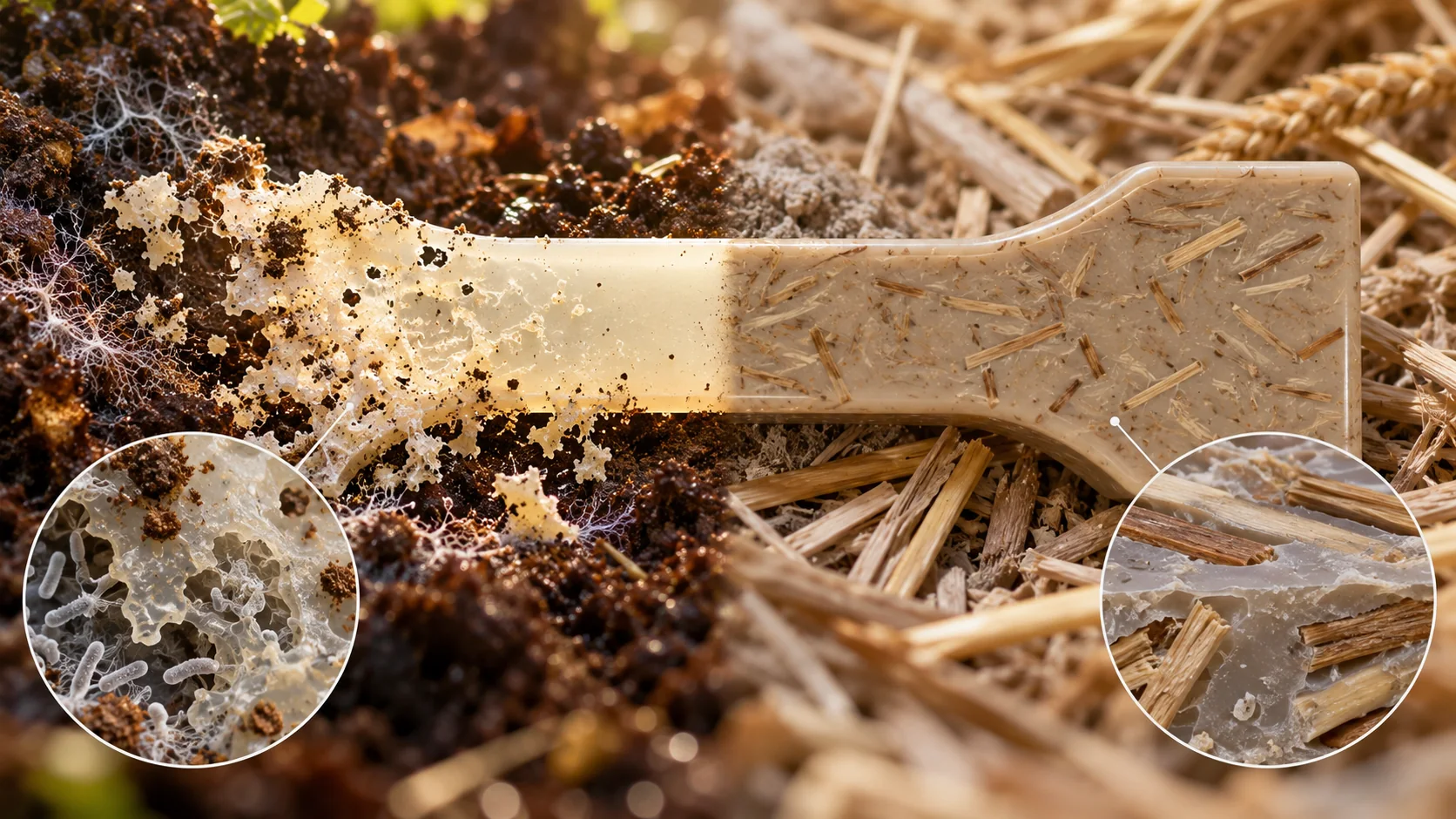
A polypropylene compound containing wheat straw, cereal fiber, wood fiber, tea residue or coffee grounds contains a renewable plant fraction, but its continuous matrix is still PP. Conventional PP is not made biodegradable simply by adding a plant filler. The plant fraction may change first, while the PP phase can remain as fragments. The accurate description is therefore a partially bio-based, plant-filled PP composite with reduced fossil-resin content—not an inherently biodegradable plastic.
| Question | What It Measures | What It Does Not Prove |
|---|---|---|
| Is it bio-based? | Renewable feedstock or measured bio-based carbon share | Biodegradation, compostability or litter safety |
| Is it biodegradable? | Microbial conversion under a stated environment and test period | Performance in every soil, sea, compost bin or landfill |
| Is it compostable? | Biodegradation, disintegration and compost-quality criteria in a controlled system | Home-compost or open-environment degradation unless separately tested |
| Does it contain plant fiber? | A plant-derived filler replacing part of the polymer compound | That the continuous polymer matrix will biodegrade |
1. PLA: A Compostable Route with a Narrower Production Window
Poly(lactic acid), or PLA, is the best-known bio-based compostable polymer used in packaging and molded consumer products. Commercial PLA is produced from lactic-acid feedstock commonly derived through fermentation of renewable carbohydrates. Its aliphatic polyester backbone can hydrolyze and subsequently biodegrade under suitable conditions. That does not mean every PLA article rapidly decomposes outdoors. Most mainstream claims refer to managed industrial composting, where temperature, moisture, aeration and microbial activity are controlled.
For injection molding, unmodified or slowly crystallizing PLA grades have recognizable constraints. Standard amorphous molded PLA can begin losing dimensional stability around its glass-transition region, and heat-deflection performance commonly sits near 55–60°C depending on grade, load, crystallinity and conditioning. Neat PLA also tends to be stiff and brittle. Impact modifiers, nucleating agents, stereocomplex routes, reinforcement and in-mold or post-mold crystallization can improve performance, but each measure changes the formula, process and end-of-life evidence that must be evaluated.
Crystallization is central to cycle time and heat resistance. Neat PLA often crystallizes too slowly for a short conventional molding cycle when a cold mold is used. Raising mold temperature, adding an effective nucleating system and allowing sufficient residence in the mold can increase crystallinity and heat resistance, but can also lengthen the cycle. A buyer comparing PLA with PP should therefore compare a production-ready modified PLA grade, not assume that all PLA behaves like one resin.
Moisture and heat history also matter. PLA should be dried to the resin supplier’s specified moisture limit before melt processing. Hydrolysis in the melt can reduce molecular weight, while unnecessary temperature or residence time can accelerate degradation and cause color, odor and mechanical-property changes. A typical injection-molding window is far below 300°C; the practical challenge is controlling moisture and residence within the grade-specific melt range, often around 170–210°C.
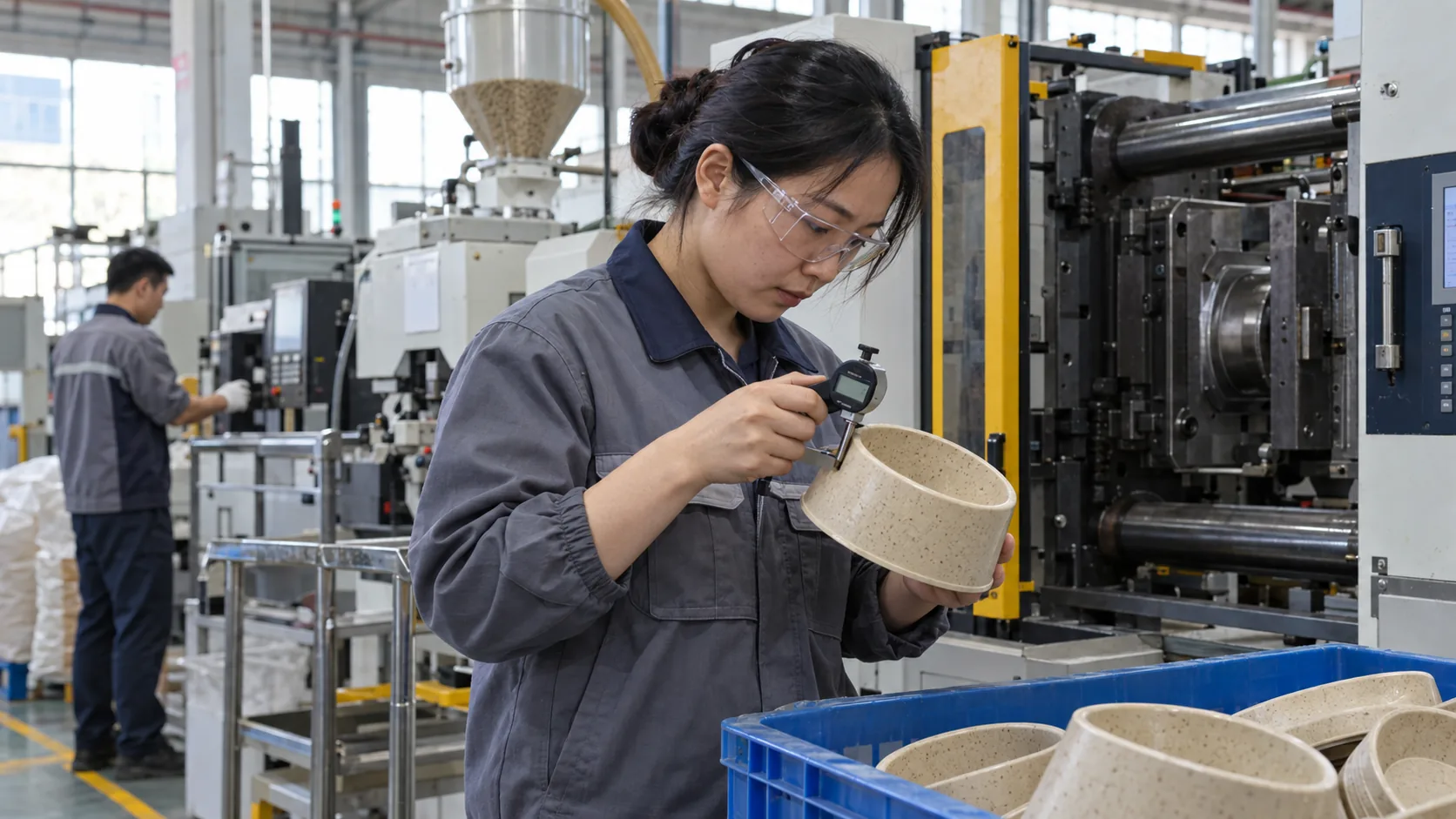
PLA is a strong candidate when collection and industrial composting are realistic and the product can operate inside the chosen grade’s thermal and mechanical envelope. Examples may include selected cold-service packaging, compostable food-service items and certified organic-waste applications. A hot-food part, long-life structural component or high-impact product requires a modified grade and finished-part validation rather than a generic PLA assumption.
2. Plant-Fiber PP: Production-Friendly, but the PP Matrix Remains
Plant-fiber PP follows a different design logic. Polypropylene supplies the continuous phase, giving the compound familiar melt processing, chemical resistance, moisture resistance and a broad balance of stiffness, toughness and cost. The plant fraction replaces part of the compound, introduces visible natural texture and can change density, stiffness, odor and surface character. It can reduce the amount of virgin fossil-based PP used per kilogram, but it does not rewrite the molecular structure of PP.
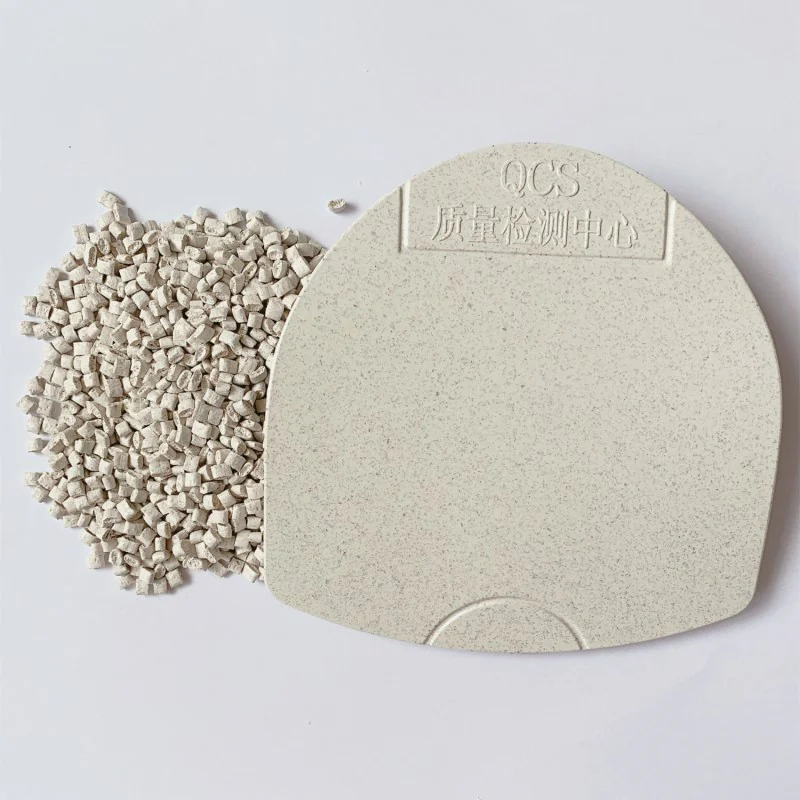
wooyopet grades such as WYC-PP P179002N cereal-fiber PP, WYC-PP P179050 wheat-straw PP, WYC-PP P179302 wood-fiber PP and WYC-PP P179506N coffee-ground PP are built around this route. Their mechanical data, MFR, shrinkage and recommended drying and molding windows are published by grade. For an injection molder, this makes the development path closer to familiar PP processing than a direct switch to a brittle, slowly crystallizing compostable polymer.
The benefit is practical rather than absolute. A stable PP-based compound can often run on conventional injection equipment and existing PP tooling after the normal review of shrinkage, filling, venting, fiber orientation and mold temperature. It may preserve hot-use performance and part durability better than a standard amorphous PLA grade. Longer service life can reduce replacement frequency in reusable products, but that is a product-level environmental benefit, not proof of biodegradation.
At end of life, the distinction becomes decisive. Environmental exposure can affect the plant fraction and weaken the interface, but this is not equivalent to ultimate biodegradation of the whole article. Fragmentation, embrittlement, surface erosion and loss of tensile strength are not themselves proof that polymer carbon has been converted by microorganisms. The buyer must distinguish physical disintegration from measured biodegradation.
3. Anaerobic-Degradation Additives: A Conditional Route That Must Be Tested
For PP projects targeting a high-solids anaerobic end-of-life route, wooyopet can evaluate a PP-compatible anaerobic-degradation masterbatch. The additive is physically blended with the finished plant-fiber PP compound. Around 1% can be used as a formulation-development starting point for suitable PP systems, followed by molding and testing of the actual production formulation.
The intended mechanism is not industrial composting. It targets biologically active, oxygen-limited, high-solids anaerobic conditions in which a methanogenic microbial community is present. Normal storage, retail, use and open-air exposure should not be described as the trigger. Equally, “deep burial” is too broad by itself: dry soil with limited biological activity is not automatically equivalent to a controlled high-solids anaerobic digestion test.
ASTM D5511-26 determines the rate and degree of anaerobic biodegradation under high-solids anaerobic-digestion conditions. Test material is exposed to a methanogenic inoculum under static, non-mixed conditions with more than 20% total solids. The result is based on conversion of sample carbon into gaseous carbon, including carbon dioxide and methane. ISO 15985:2014 uses the same general high-solids anaerobic-digestion principle and measures evolved biogas; it remains current after confirmation in 2024.

These standards are test methods, not universal pass/fail certifications. ASTM D5511 specifically limits a performance claim to the numerical result obtained and the actual test duration. It does not permit an unrestricted “biodegradable” claim, and the result must not be extrapolated beyond the test. Therefore, a masterbatch dosage, supplier formulation estimate or raw-material result cannot substitute for a report on the final compound or finished article.
| Evidence Item | What the Buyer Should Verify | Why It Matters |
|---|---|---|
| Test environment | High-solids anaerobic digestion, aerobic composting, soil, marine water or another defined condition | Results from one environment cannot be transferred to another |
| Test specimen | Final molded formulation, including fiber, pigment, additive and production history | A masterbatch result does not describe a diluted finished product |
| Reported metric | Carbon conversion, evolved biogas, disintegration, mass loss or molecular-weight change | These measurements are not interchangeable |
| Duration and control | Actual exposure time, reference material and blank correction | A percentage without time and controls is not comparable |
| Claim wording | Exact condition, method and measured result | Prevents a conditional result from becoming an absolute marketing claim |
Adding the masterbatch also requires normal engineering validation. The initial PP processing window may remain close to the original compound, but MFR, color, odor, impact strength, tensile retention, migration requirements and long-term storage stability should be checked. The same dosage cannot automatically be transferred from one PP grade, fiber loading or wall thickness to another.
4. Compostability Is Not the Same as Anaerobic Biodegradation
Industrial compostability standards describe a different end-of-life route. EN 13432 applies to packaging recoverable through composting and biodegradation. Its familiar 12-week requirement concerns disintegration: after the specified composting test, no more than 10% of the original dry mass should remain as fragments larger than 2 mm. The biodegradation criterion is assessed over a longer period—up to six months—and requires at least 90% biodegradation relative to the reference or in absolute terms as defined by the standard. Chemical characteristics and compost-quality effects are also part of the assessment.
ASTM D6400 similarly establishes requirements for labeling plastics and products as compostable in aerobic municipal or industrial facilities. Neither EN 13432 nor ASTM D6400 should be used as a synonym for anaerobic landfill degradation. Conversely, an ASTM D5511 or ISO 15985 result does not prove industrial compostability.
The distinction matters in purchasing documents. If the brand requires certified industrial compostability, the material and finished package should follow the applicable compostability route, typically using polymers and additives designed for that system. Plant-fiber PP with an anaerobic additive follows a different testing and claim structure. It should not be sold under an EN 13432 or ASTM D6400 compostable label unless the finished item independently satisfies that specification.
5. The EU Bamboo-Plastic Case Was a Food-Contact Compliance Issue
The European coordinated action commonly called “Bamboo-zling” identified 748 cases involving plastic food-contact articles containing unauthorized bamboo powder or other plant-based additives. The action involved 21 countries; 644 cases were products found on the EU market and 104 were border rejections. A majority of the identified illegal products came from China.
This event is often mixed into biodegradability discussions, but its principal issue was food-contact authorization and misleading presentation—not proof that every plant-filled plastic is technically unusable. Under EU plastic food-contact rules, the substances used in plastic food-contact materials must be authorized for that purpose. Bamboo powder and several other plant additives were not on the relevant Union list.
The purchasing lesson is precise: environmental language does not replace regulatory authorization. A food-contact project must verify the exact resin, plant additive, colorant, processing aid and finished formulation for the destination market. A claim such as “natural,” “plant-based” or “reduced plastic” cannot compensate for a missing food-contact compliance route.
6. How Procurement Should Select the Route
Begin with the use phase, then work backward from the real waste system. A product that must hold hot food, survive repeated drops or maintain a snap-fit for years presents a different material problem from a certified compostable liner collected with organic waste. Selecting the environmental label first and forcing the part to follow it is usually the expensive route.
| Project Requirement | More Practical Route to Evaluate | Required Validation |
|---|---|---|
| Hot use, impact resistance, dimensional stability and conventional injection molding | Plant-fiber PP selected by grade and part geometry | Mechanical, thermal, odor, appearance, migration and production trials |
| Industrial-compost collection with moderate service demands | Certified compostable PLA, PBAT or another purpose-designed system | Applicable compostability specification on the finished product |
| Measured renewable content without a degradation claim | Plant-fiber PP with a declared plant fraction | Composition control and, where claimed, recognized bio-based carbon testing |
| High-solids anaerobic digestion is the defined end-of-life route | PP-compatible anaerobic-additive trial in the exact plant-fiber PP formula | ASTM D5511 or ISO 15985 result with condition, duration and carbon conversion |
| Food-contact application | Only a formulation with a valid destination-market compliance route | Finished-formulation migration and documentation review |
If the only target is lower fossil-resin use and a natural molded appearance, a plant-fiber PP compound is direct and production-friendly. State the actual plant fraction or measured bio-based content rather than calling the entire article biodegradable. If certified compostability is mandatory, select a material designed for that route and confirm that collection infrastructure exists. If anaerobic biodegradation is required, define the target system and test the finished formulation under the relevant method.
Do not group HDPE blow-molded personal-care bottles into a PP-only additive claim. Those bottles normally use a PE matrix and require a PE-compatible formulation and separate validation. The same boundary applies to ABS: an additive developed for PP should not be assumed to work in ABS without a compatible carrier, processing study and test evidence.
7. Conclusion
Plant-fiber composite plastic is not one end-of-life category. A plant-fiber PP compound contains renewable plant material and can reduce the fossil-resin share, but its PP matrix remains non-biodegradable unless the exact finished formulation demonstrates a specific, conditional degradation pathway. PLA can provide an industrial-compostable route, yet its heat resistance, toughness, crystallization, moisture control and cycle time must be engineered for the product.
The two routes solve different problems. PLA prioritizes a controlled composting pathway when the use requirements and waste infrastructure support it. Plant-fiber PP prioritizes production compatibility, performance and partial fossil-resin replacement. A PP-compatible anaerobic additive can be evaluated where high-solids anaerobic digestion is genuinely relevant, but the claim must follow the finished-product test result rather than the additive percentage.
For procurement, five questions settle most projects: What is the continuous polymer matrix? What renewable fraction is actually present? Which environment is expected at end of life? Which standard measures performance in that environment? Was the final production formulation tested? Once those answers are documented, “bio-based” and “biodegradable” stop being competing slogans and become separate, verifiable specifications.